Saturday, August 30, 2014

This and That

I've had a hard time deciding on a topic for this issue.  It seems that  there are quite a few photos in my files which would make 3- or 4- picture topics, so perhaps I'll just start setting some scenes in place and see what happens.
We never know what we might see, when we take a road-trip
here.   One afternoon we were about 7 km from home, returning
from a day of errands in San Jose - and when our van came around
a curve, the driver abruptly braked to a stop!  I don't know why
ducks and geese would be taking a hike, but they do it in a
pretty orderly manner, it seems.  As I took this photo through the
van's applique-tinted windshield, it is just a little blurred.
This bridge replacement project required several months to
complete.We traveled back and forth enough that I was able
to accumulate a fair record of how the project progressed.

  The temporary bridge which was put in place required three
sets of trusses on each side; even so it was rated 15 tons
instead of the 20 tons of the original bridge.
Coconut palm tree trunks are the most common material used
here for heavy construction bracing.  These are part of the forms
for the retaining wall which will hold back the buildup of rocks and
earth which will become the approach an one end of the bridge.
As each support-wall was completed, it was braced with tree-
trunks, and reinforcing steel plus forms were constructed  to
pour the bridge's girders in-place.  Most bridge construction
in the USA now uses pre-cast  concrete girders which are
brought on trucks and set into place with a large crane.  Here,
nearly everything is made at the site, mostly by hand.  A
large track-hoe usually handles the heaviest part of the work.
After the support walls have been connected by the cement
girders, heavy planks are placed to serve as forms for the
concrete road decking.  Here, the bridge is nearly complete,
but the bypass bridge will remain in use until the guard rails
and other details are completed.
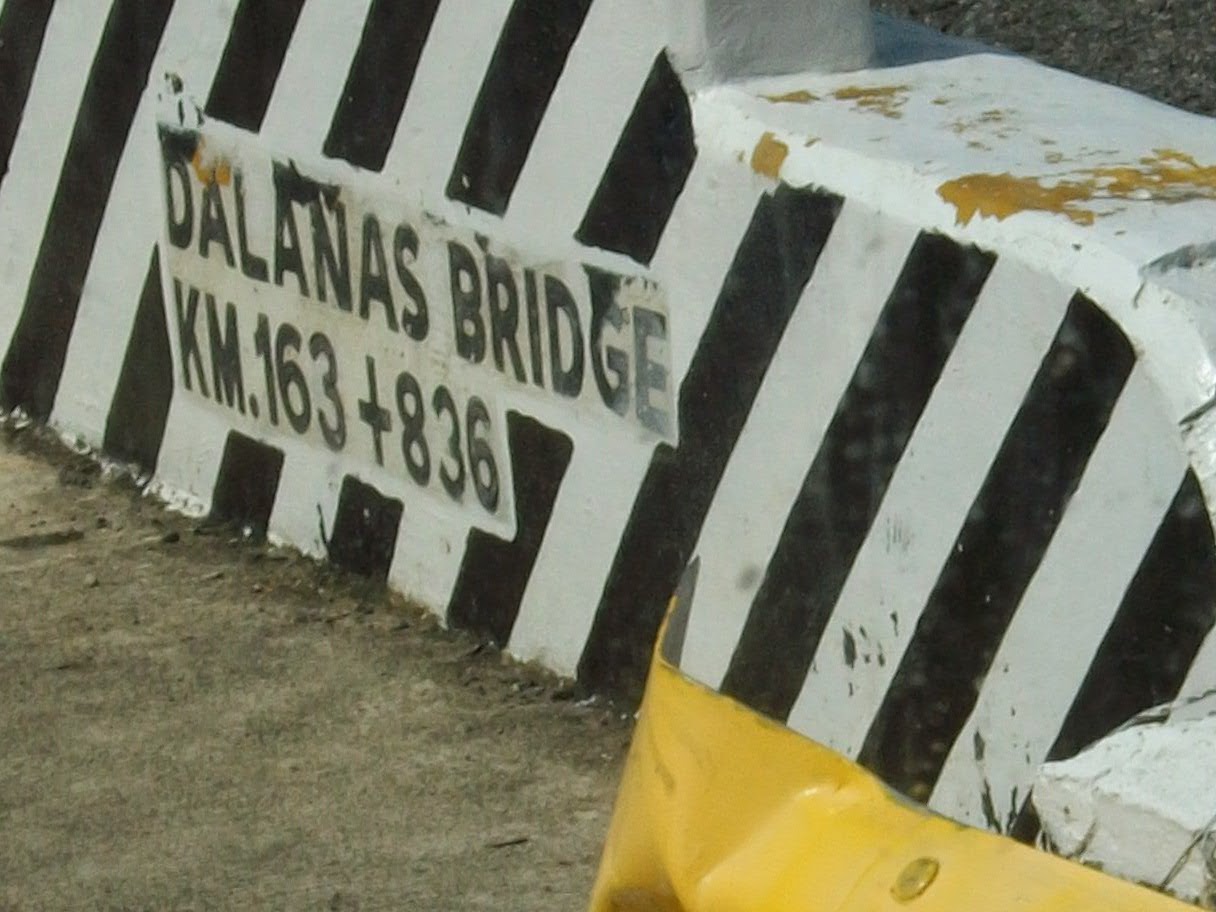
This is NOT the same bridge as above; but the end of every
bridge on the main highway is similarly marked, with the exact
distance in kilometers and meters from the "Zero-Kilometer"
which is at the old Provincial Capitol building at Iloilo. 
Additionally, the highway itself has a post at every km., giving
distance from Iloilo;  it took me a year  to figure out the lower
marking - "B-10," here.  No, it's not road-BINGO.  Turns out
to be the distance to the next municipality - "Barbaza," on this
post, 10 km. away.  The opposite side of this same post is
marked "T-2," as Tibiao is 2 km. in the opposite direction. Each
post is similarly marked along the entire length  of the highway.
I have found some disagreements between the highway posts
and the bridge-distances, however; I suspect that would be the
"human factor" creeping in. Perhaps different departments 
determine how the distances are measured and marked.

I found a few photos of local fruit in my files, so I'll give you a look at them.

Someone brought us this cluster of "dwarf coconuts" from a
nearby tree.  The "nuts" are about same-size as regular coconuts,
but the tree only gets 10 or 12 feet tall - which really beats having
to climb 40- or- more feet for regular coconuts!  Inside, they are
pretty much the same as other coconuts, but outside they are
smooth-green-skinned, instead of having a rough thick fibrous pod.
  The golf-ball sized rambutan resemble miniature sea-urchins.
The inside is a tough-jellybean texture, which tastes slightly
tarter than a green seedless grape.
The coffee cup gives size-reference to this papaya.  Some 
papaya are twice this size - I've seen one crash to the road,
falling off a tree just in front of our bus.  A nearly 20-pound
fruit would make quite a "wham!"  if it actually hit a vehicle.
The inside orange flesh tastes somewhere between peach
and cantaloupe.  I laughingly call papaya "the sailor fruit."
(Repeat the underlined words and see if you "get it.")
Bamboo shoots (but its aim is poor?).  We're used to getting
these in about a 6-ounce tin can, in the USA.  This is what those
little  pieces come from - - I had no idea the shoots were so
large.  Here, they will slice and cook up a large pot-full, often
with coconut "milk."

Pomelo is about 10-inch citrus 
fruit which has giant- sized seg-ments inside.  The flavor is like a sweet grapefruit, but the ones I've had so far were pretty dry in-side.  I don't know if this is their nature or if it was from poor growing conditions.

Here are a 3-foot squash (similar in flavor to zucchini, but with
larger seeds and more gourd-like hollow inside), "yard-long"
green beans, "acorn" squash, asian eggplant, okra, and white
radishes.
 Mix-with-water "kool-aid" type powdered drinks are very common.
I have seen NO "Eight O'clock" coffee here, only beverage powder.
Nestea markets bottled tea and several flavors of powdered tea.  I
have been in a store unable to find ORANGE Tang - but able to
find Tang flavors of grape, strawberry, watermelon, etc.  The four
brands visible here are most common, but there are others.

There are quite a few differences between Philippine and U.S. foods, even in types which might be expected to be "pretty much the same." In general, Philippine versions of such things as tomato sauces, bread, peanut butter and beverages are noticeably sweeter than the U.S. versions.  Filipinos in general seem to prefer having their foods sweeter.  This may be partly because cane sugar is the norm for sweetening, here - and it is sweeter than any corn-syrup product, and also considerably sweeter than the beet-sugar which is most common in the U.S.  The Coca-Cola and other soft drinks are stronger-flavored and sweeter than the U.S. versions.  Diabetes was rare here 20 years ago, but is becoming common.
     Many U.S. food companies have processing facilities in the Philippines, so familiar brand names are everywhere here.  Hunt's, McCormick, Green Giant and the beverage companies are among these.  Also, many of the U.S. products are sold under different names brands here - "Nova" chips sold here are "Sun" chips in the U.S., and I suspect that Republic Biscuit Company here is related to National Biscuit Co. (Nabisco) U.S.A.  
   Snack foods are packaged in "individual-sizes" only, it seems; this is likely more profitable for the producers, and such items are often re-vended so the smaller sizes are most practical. Unflavored chips (just-plain-salt) are found here rarely - overly-sweet cheese flavorings and barbeque flavorings dominate the chip row.
   I have seen NO roasted-ground coffee in groceries here, though I have heard a couple people mention that it is available.  Restaurants with large-volume such as Jollibee have Bunn-o-matic type brewing, so they manage to obtain ground coffee.  But what I have seen in groceries is all instant coffee, which is also somewhat stronger (if you buy "coffee only" products) than the instant coffee in the U.S. as best I can remember.  But MUCH  of the instant coffee is in coffee-mixes which already have sugar and powdered creamer in various proportions; 3-in-1 and 5-in-one are quite common, though I also don't know what the 4th and 5th ingredients would be.  Individual-cup packets vie with larger packages; we prefer to buy our ingredients separately and proportion them to our tastes.  Nescafe and CoffeeMate have the largest portion of the market around here, it seems.
    There seems to be no dairy industry in the Philippines.  Milk is available in various powdered forms, evaporated or condensed in cans, or vacuum-packed in boxed plastic envelopes, usually 1-liter. (WalMart has these, now.) Thick cream is packaged in the envelope-boxes, but in 1- cup size (about like a lunch juice-box).  "Cheese" is all processed-type sold in little boxes ("Velveeta" type), and "Cheese- Whiz"  types in jars, although some groceries in large cities have "imported" food sections where various natural cheeses are available but expensive.  Yogurt products are difficult to find even in San Jose, population nearly 60,000.  Sour cream is unheard of. The milk products seem mostly to originate in Australia, and the processed fake-cheese is made in the Philippines from imported ingredients.
   I had no plans to comment about Philippine foods in this posting. It just "seemed to flow" once I'd put up the fruit photos. But, food is a subject close to my heart - I might say that it is seldom more than a few inches away!  No photos of the above, because I hadn't expected to need them.  I am also currently "in-between cameras" as my nice little Sanyo finally wore out and so far I haven't found a suitable replacement.

There always seem to be a lot of little projects around here.  At least these provide plenty of variety.
We needed insulators to run some wires around, recently.  It
turned out that using the top parts of some plastic medicine-
bottles (bottoms sawn off) worked fine; when pulled taut, the
wires settle nicely into the "grooves" between the bottle-
shoulder and the cap.
The gardening trowel   which was in use kept bending at its
handle.  I found some sturdy angle-iron and cut it to shape
some trowels - above, #3 and #4 of 4 that I made.  The
handles of these two were "lathe-turned" by chucking a large
screw into the big electric drill, and clamping the drill into a
vise, then putting the wood on the screw so that I could shape
it with wood-rasp and files as it spun.  As my technique im-
proved, the handles got a little more stylish. 
  I waited several months for the guy who was going to do some
fine-paintbrush work for me; I don't have very good skills with
such things as lettering and pin- striping.  I finally decided to
try doing the markings on my water-level gauge with a felt-tip
permanent marker.  This has stayed on pretty well.  The words
being in German (hopefully correct) is a little joke which works
for about 3 different reasons. 
A 16- inch stainless steel bowl makes a fine reflector  for the
yard- light on our new storage shed.  It will never rust, never
need any maintenance, and it was very reasonably priced.

Well, that's sure not everything that I could put into a blog posting.  This time I think I managed to get a lot of variety,  and I hope that at least part of it caught your imagination and interest.  I have quite a large number of photos still on-file which show various aspects of our life here in the Philippines, so it will not be too long a time before I'm looking through them for another posting.

Meantime, wishing you all good health, interesting and challenging things to occupy you, and blessings in all your endeavors.

Tim and Bernadette Larson, Philippines


Thursday, July 31, 2014

Salt and Sulu

Salt and Sulu?  In this area, at least, the two have a lot to do with each other.  The part of the ocean which our part of Panay Island borders is called the Sulu Sea - - who knows?  maybe Gene Roddenbury  was perusing a map and happened on the name before he created the well- known helmsman of the Starship Enterprise 50 or so years ago.  The Sulu Sea is separated from the South China Sea by the long skinny island of Palawan to its northwest; the islands in our vicinity hem it in on the east, and Borneo, Malaysia, is southwest. (link,  Sulu Sea 
move a little west and north on the map and you will see our relation to Vietnam and Taiwan). Our island- name is Panay, just above and right of center.  Sulu Sea is notable for being very calm, nearly always;  This is apparently because it is surrounded by land masses which shield it from the  action of the larger seas beyond its basin. Well, that's enough of "Sulu" for a while.

Salt relates to "Sulu" because of course it is a saltwater ocean.  Salt also happens to be a "cottage industry" here, as several families nearby create evaporation systems each year to take salt from the seawater.  In our household, we cook almost entirely with pure, natural sea-salt  which is produced within easy walking distance of us.  I have not interviewed any of the salt makers, but over a period of time I made photos of their process which generally show how it's done.


Making salt requires a lot of concentration.  A large area of
beach is cleared of rocks to a depth of several inches - in this
case the space appears to be about 30- x 30- feet.  Considering
the rocky nature of our beach, this is a lot of hard work.  Sand
is gathered from the tide-zone of the beach, which is mostly
swept clear of rocks by the ocean's action.  This sand is carried
up to the site 50 or 60 feet away,  and carefully sifted through
hardware-screening so that is is uniformly smooth and fine, 
then spread out over the area.
For a period of several days sea water is carried up to the site
and distributed over the sand from a "sprinkler jug."   The water
evaporates in the heat from the sun, and more water is added
until several cycles of sprinkling and evaporation have been
completed. (The jug was apparently one of the containers which
have vinegar,soy sauce, and such liquids, which are measured
into smaller portions and re-vended.  These re-used jugs are
everywhere, here; we have cut them in half and added re-bar
"handles" to make cement buckets out of them.  See August, 
2013 "A bunch of Stuff" via the archive navigation at right.) 
The top layer of sand will have accumulated salt as the water
evaporated.  This layer of sand is collected and carried to
a large basket (4- feet?), which has been elevated on a
bamboo platform a couple feet above the ground.  Salty
sand is deposited in the basket, and water is poured through
it for several cycles.   This water is carefully collected in a
plastic bucket as it drains through the sand and the basket
material. The resulting water probably has several
times more concentration of salt than plain seawater. 
The hyper-saline water is  poured into carefully leveled "pans"
created by lining the nearby ground with plastic sheeting.  As
it evaporates, it leaves behind it a residue of pure salt crystals,
which above may be seen gathered in the corner of the pan,
to later be collected and packaged.  Bernadette recently
bought 5 "gantas" (scoops) of salt, and was given one extra.
This figures to about 17 quarts volume, and the price was 
about $3.50  USD, which is the "low end" of a day-wage here.


Sulu Sea provides a constant backdrop for our activity here, as we are seldom more than 100 yards away from it;  Our house is  just about that distance from the water; it is less than a 2- minute walk.  The main highway here follows the coastline, so on our travels we pass for many km. along shoreline vistas which remind me a lot of Pacific Coast Highway in California, except that the sea here is usually much more "pacific" than the Pacific Ocean.  The wave-activity is often only 4- to 8- inches in height, and it is not uncommon for the water to lap up to the shoreline without actually "breaking" into a curl.

This is the view looking southwest from the beach, if you walk
from our house to the end of a path which passes between
the mostly-bamboo houses on the west side of the National
Highway.  Our neighborhood ("barangay") of Malabor has
about a mile of ocean frontage;  the shape of the shore is
a gentle curve, with the hills in-between Malabor and the next
municipality to the south, which is Barbaza.   I walk along
this stretch of beach nearly every day.  (I invent nicknames
and other devices to help me remember names;  "Barbaza" reminds
me of "Barbasol" shave-cream - - so I remember - - -)
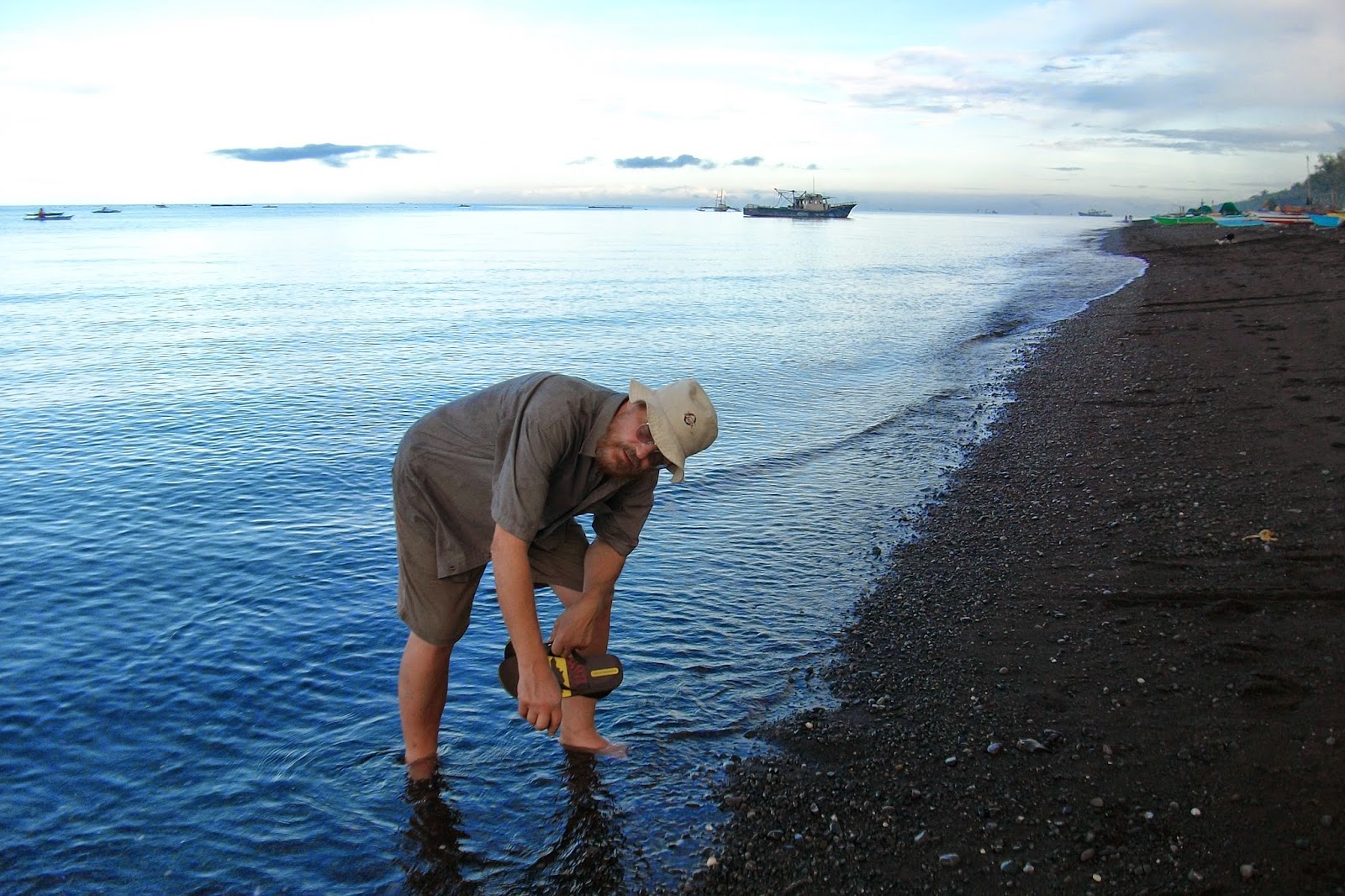
Sometimes I have company while I'm walking; this time, I think
Bernadette is who took the photo.  It shows the almost pond-
like calmness of the ocean.  I often stop and pick up rocks that
have different colors, or patterns which are interesting.  The 
beach at a glance looks mostly gray, but it surprises me how
much variety of colors seem to catch my eye when walking.


Contrasting the usual appearance of Sulu, this photo is from
a period of heavy storms last October.  The wave appears to be
about 5 or 6 feet tall.  Oddly, there never seem to be any long-
travelling breakers here - the ocean may be quite rolling and rough-
looking, but the curls don't form until about 20 yards from shore.
This is about as rough as I ever see it, and it happens pretty rarely.


Sometimes when I walk, there seems to be nobody out on the
beach - but it's a pretty unusual day when I see no sign of activity.
This sand sculpture seemed pretty recently abandoned one late
afternoon; often there are a large number of all ages of people,
socializing and tending to various tasks.
Lots of the fishing boats now have lights extending over the
sides to attract fish during darkness.  These are all 12-volt
florescent lamps, readily available here.  The lights are powered
by heavy- duty vehicle batteries, and there is a small industry of
providing battery charging service to the fishermen.  Nearly every
day in late afternoon there will be a number of people out installing
batteries, tinkering with boat motors, mending nets and doing other
chores associated with fishing.   Some boats go out at dusk,and
some wait until after midnight;  if there is a successful night, early
morning will come with people vending fish in the neighborhoods,
loudly shouting their wares as they pass by.

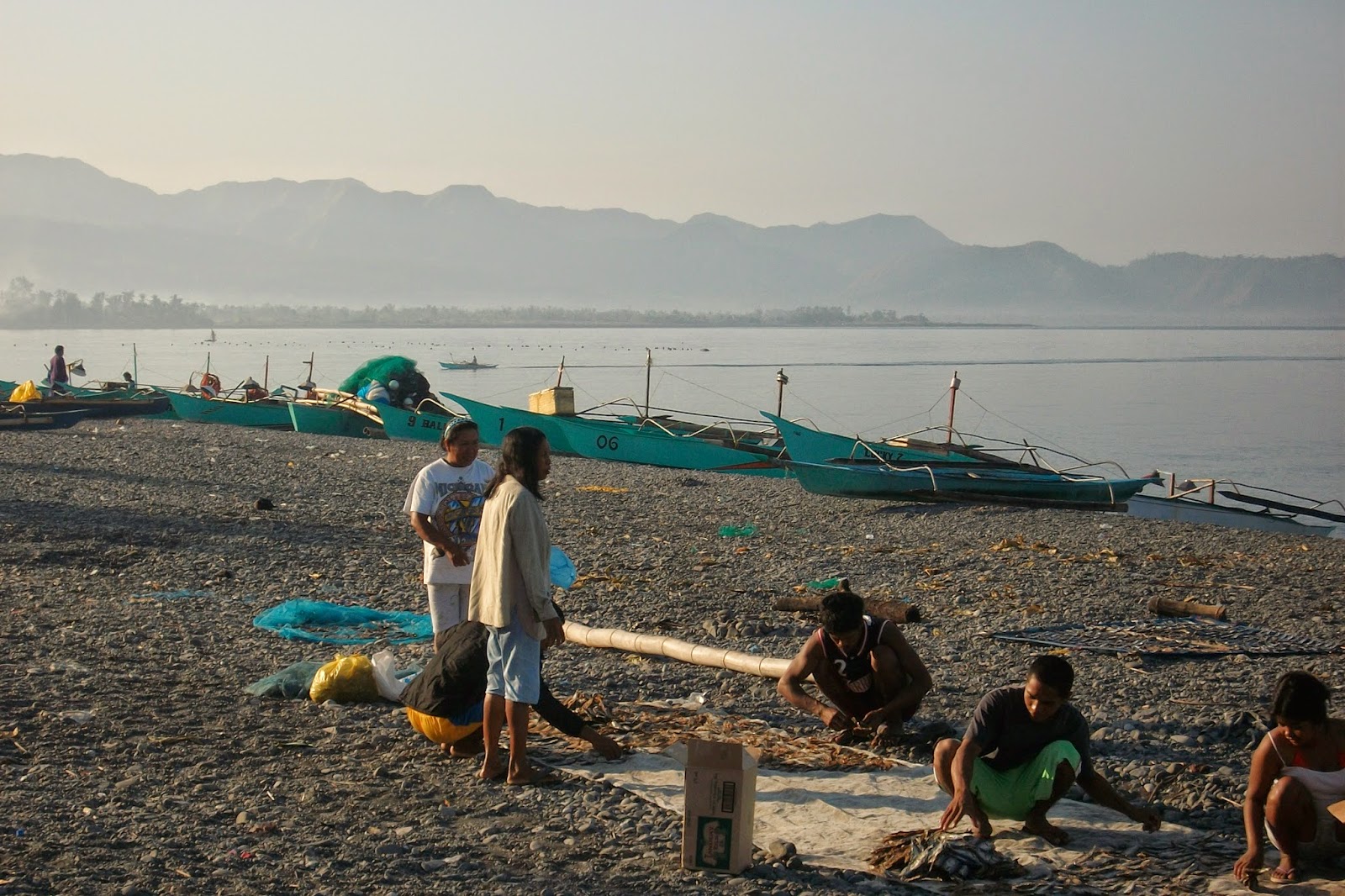
Any time there is a surplus of fish, people will be spreading it
on mats, tarps and roofing-tin, to dry in the sun.  Almost any
sunny day will be long and hot enough to thoroughly dry a batch
of fish;  early in the year, the entire beach would seem to be
covered with fish drying - - a necessary provision for other times
of the year, when harvest is 2 or 3 months away and the fishing
is poor.  The dried fish are suspended in sacks from rafters
inside houses, where cats and other creatures can't reach.
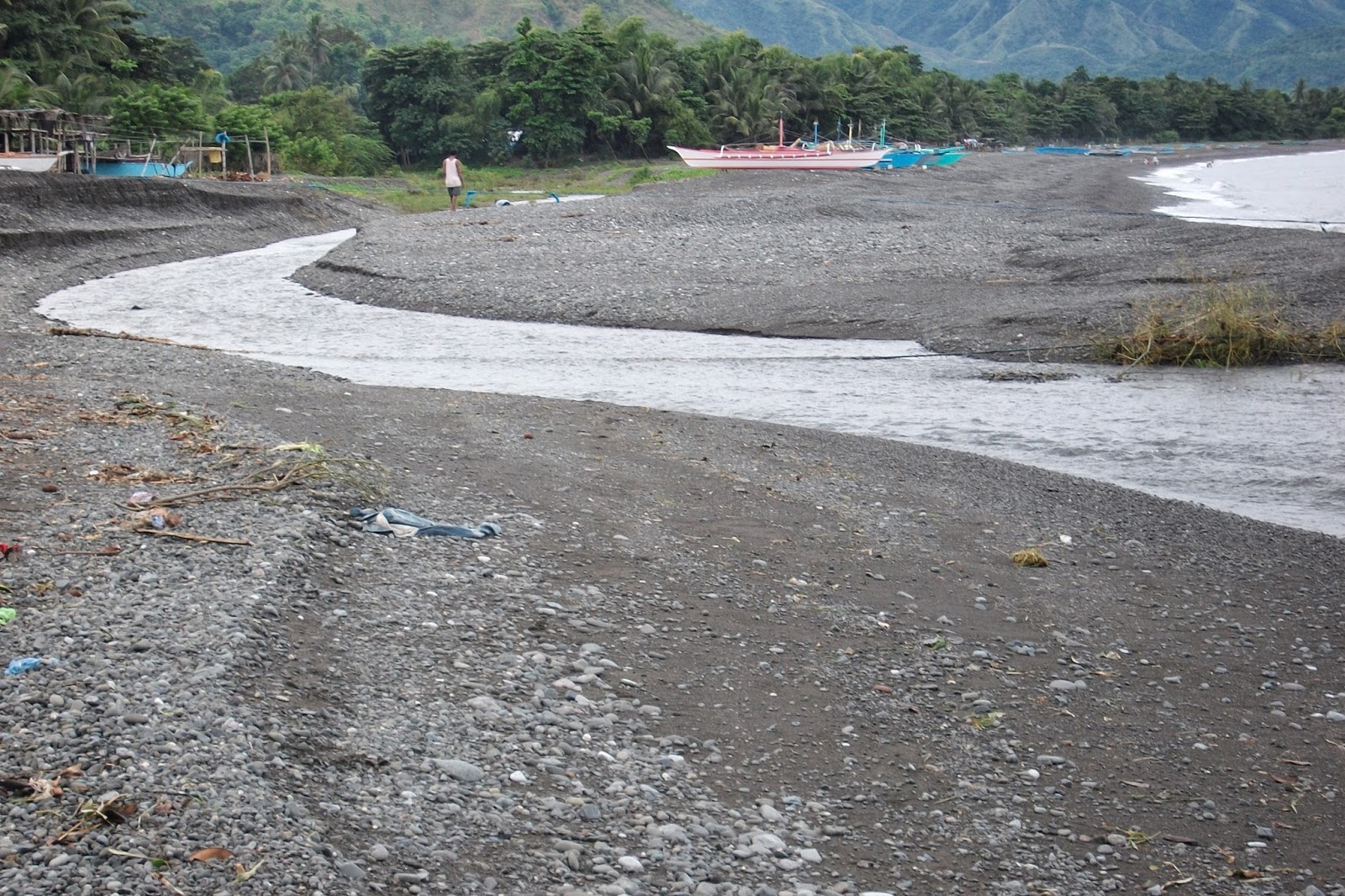
Walking 300 or 400 yards south along the ocean shore, I
encounter the mouth of the Sabai river; it is rainy season,
known because this exit into the ocean is a "dry wash" for
about 8 months of the year.  With the sea  on my right, the
National Highway is about 40 or 50 yards to my left, around
the river's left curve from the person walking.  This "S" bend
of the Sabay's mouth is very distinct on the  GoogleEarth 
satellite photo's of this area; in fact it served as a landmark
for me when I was poking around trying to see if our house-
roof is visible.  The Sabay and other features of the area stand
out quite well if you use the link below, and do a little 
"panning  and zooming."


You can see our house, from there! Here is a link to the Google Maps satellite photo of our area.  ( Malabor neighborhood )  Until recently, the file photo was before the "older" house on our lot was built; the current  photo shows our older house- roof, but not the current one-year-old house; also lacks three other  houses on the street which are more recent than 3 years.   In the photo, note the Elementary school, a large narrow building upper-right.  The "V" sidewalk in front of the school points out its gate and onto our street.  The third roof along the street ("above" the street in the photo) is our place.  The opposite side of the street in this photo has only one house; now, it is completely filled in.  Panning south a little distance from the elementary school brings you to the next large building plainly visible, the rice cooperative's warehouse, which is on the edge of the Sabay river.  Slightly west of that is the "S" curved channel where the river enters the ocean.


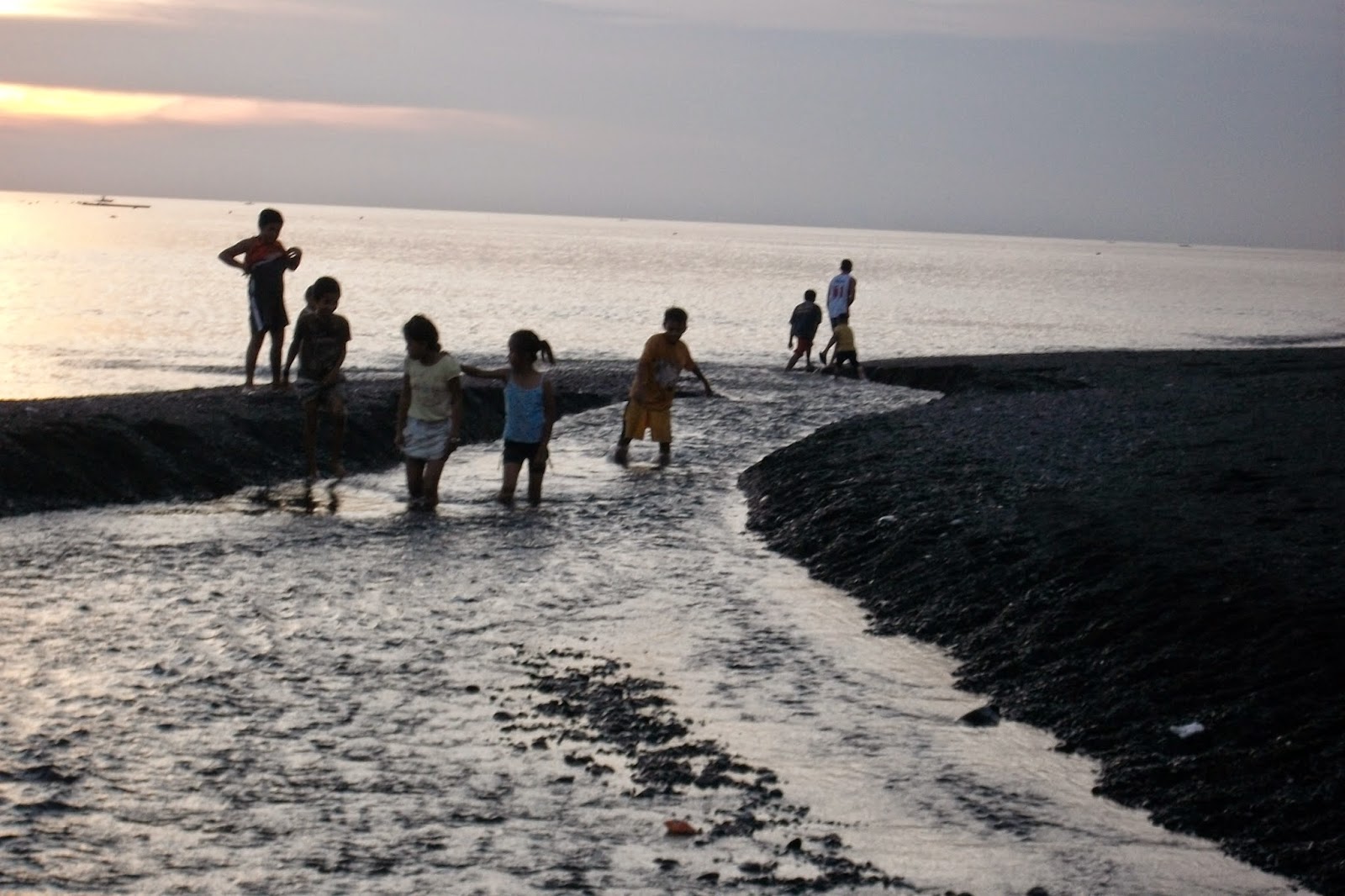
Meter people enjoy kicking around in the fresh water where
the Sabai enters the sea.  (Meter people?  yeah, I call them
that because they're about one-meter tall.  Smaller ones are
half-meter people.)
 When a fishing boat comes in, almost everybody nearby grabs
hold and helps to skid it ashore, over the hump of the tide-line.

 Seems like this afternoon is one of several when the day-
fishing has been good; so lots of people are gathered waiting
for boats to come in so they can help drag them ashore and
sort out the catch.
I never know what I might see when walking on the beach; the
cow and calf being walked along the shoreline was an eye-
opener, but logically explained;  a good swim and soak in
salty ocean water persuades all the undesirable insects
to leave mama- and- calf alone.

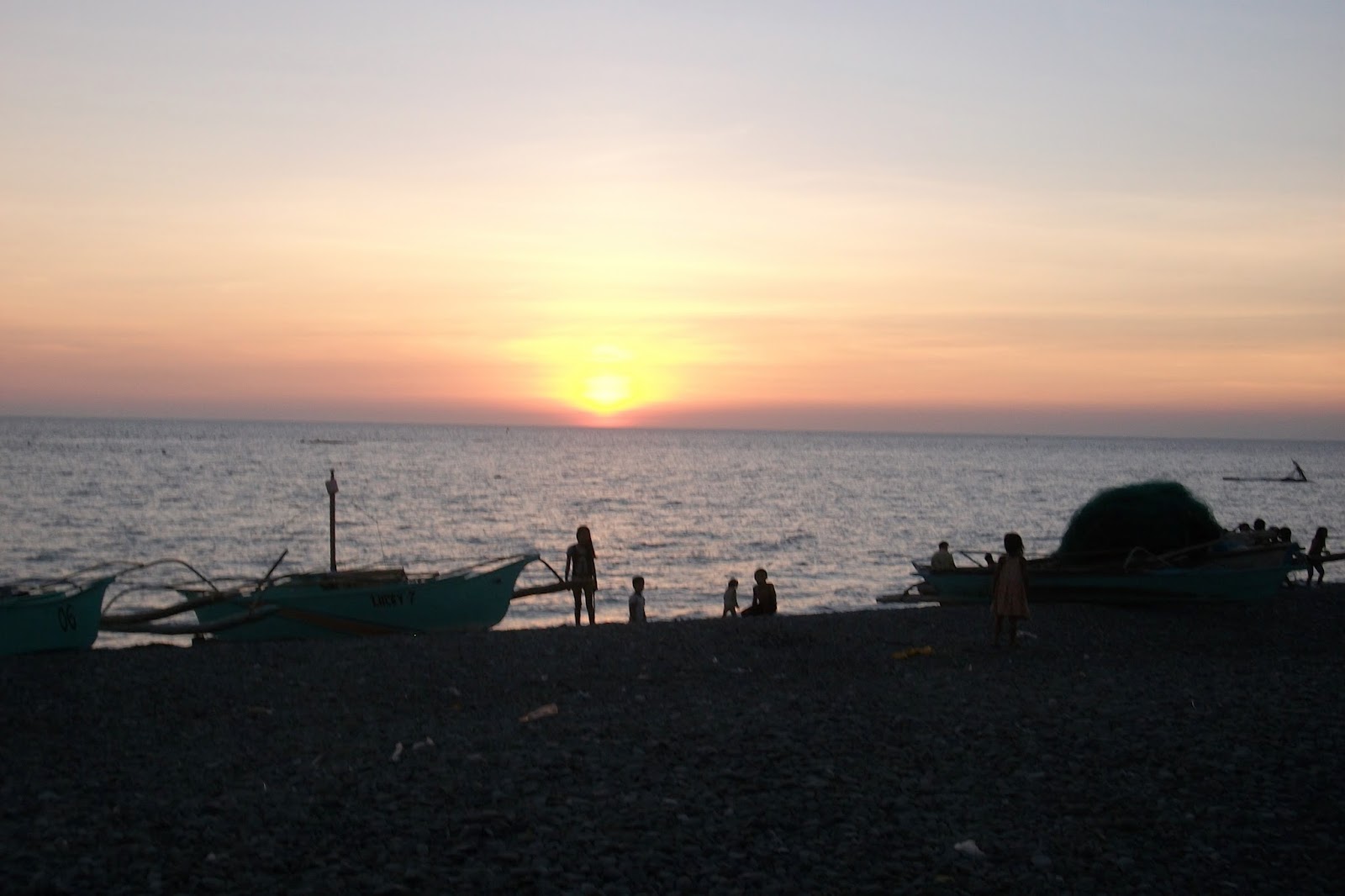
I see lots of sunsets in my late-afternoon walks, and every
single one is different from the others.  If you're ever in our
area, be sure to drop by and I'll show you the latest sunset.


Meanwhile we hope you are enjoying your part of the world as much as we enjoy ours.  We seem to stay covered-up with things to do here, and we have hardly begun to try to do the "homestead" style gardening and other food producing which we hope eventually to accomplish. (We would like to "feed ourselves" as much as possible, with fresh and home-produced foods, to eventually include home-made breads, cheeses, meat products, and of course all the usual "garden" vegetables and products.  This will be quite a while happening, as the learning curve for this place seems pretty steep.)

For now,  we'll get this issue "salted away. . ."

Have a blessed day!

Tim and Bernadette Larson, Philippines

Wednesday, June 18, 2014

Rice is Nice (2)

I only got part-way through the rice process in my last blog before the typhoon - and the resulting communication blackout - of early last November.  I think that just a few photos will be enough to get that finished, and then perhaps I'll look at some of my "miscellaneous" short topics.  (The Blog Archive  navigation just to your right will take you back to 2013, Oct. 25 "Rice is Nice (1)" so you can review if you want to.)

So far in the rice process, I've shown you plowing, harrowing, planting and seedling re-planting, reaping, threshing, and winnowing.  At this point the rice is out of the husks in separate grains, but there is still an inner hull on each rice grain.  The rice is purposely harvested before this inner hull is dry enough to remove;  if the rice were on the stalk for a longer time and got drier first, the grains would fall off the stalk and be lost on the ground when the stalk was cut.  When cut, the rice grains must stay together in seed-heads so they can be carried in bundles and threshed.  Then, the separated grains must be dried enough for the inner hull to be removed.  At this point the rice is called "palay," (I remember it with the word "Malay" as in Malaysia) and it is often sold to a rice cooperative or other commodity producer who will continue the processing.

Solar rice drying is the only method I've seen used in this area.  The rice
is often spread on the roadway on a hot day, for the sun to dry the grains.
Traffic goes around it out of respect for food in a poor, often-hungry place.
Sometimes, if there is enough room, it is put out on tarps or bamboo mats
on the road-shoulder.  A few large-scale rice-processing businesses have
large concrete-paved areas for drying purposes (often dual-purpose, with
basketball goals).  In all cases, the rice is carried out in bags, dumped, and
raked and turned over by hand until dry.  All this work would be done in
USA by fuel-powered equipment, possibly even all one giant machine in
the field, reaping, threshing, winnowing, drying and bagging.  Dried palay
can be stored in bags for a number of months or longer, until it is needed.
Lots of households keep sacks of  palay, and call a portable rice-
polisher to come out and mill it for them a bag or two at a time;  The
owner of this mill laughed and called his vehicle a "Bora-Bora car,"
but most of the others I've seen aren't much newer than this.
Bags of rice are handed up to the man on the roof, who dumps them
into a hopper . . .
. . . and the grains fall through a series of rollers covered with coarse mesh,
which "scuffs" the hull off of them.  Nearly all the fiber, and most of the
vitamins, minerals, and other nutrition are removed in this process.  What
remains is the polished white pellet of nearly-useless starch which most
Filipinos and Americans prefer to cook and eat.  If ONLY the fibrous
part of the hull were removed, leaving the bran and other nutritious parts,
the rice would have much higher nutritional quality.
Quite a maze of belt-driven pulleys and shafts drive all the various rollers
and blowers which polish the rice.  Power comes from the vehicle's
engine via a geared power take-off.
One stream of material, the white rice, is collected from a chute near the
vertical post above.  The other barely-visible stream of material, just
above the word "collected," is the hull and bran material.  THIS  is
kept - or sold - and mixed with water to form a nutritious gruel for
poultry.  We were formerly buying it for our geese, but now we have
enough from our polished rice to feed them.  We get the rice, THEY
get the nutrition.   I haven't found a way yet to "partially polish" the rice
and keep some of the good "brown stuff" on it for myself. 
A view of the vehicle's strictly functional retro- interior.  Driver rides in
"solid comfort" on a 2 x 12 plank.  I have  never seen a rice-machine vehicle
moving faster than 25 or 30 miles- per- hour; likely for good reasons.

That's about all I know to share about rice growing and processing.  Here, they usually cook it differently than Americans do, preferring it softer and more mushy.  Rice is often eaten nearly plain, but with whatever is available to put over the top and flavor it a little.  In our household I notice that the others lean much more towards "plain" than I do, perhaps using less than 1/3 as much "sauce" and vegetables or meat ingredients compared with what I cover my rice up with.

I have in mind a recipe, actually more like general make-to-suit-yourself directions for a Filipino "national dish" called adobo.  The sauce combines vinegar, soy sauce, and water in "cook's preference" to make a flavor that ends up tangy with "just a hint" of salt, plus garlic, onion and 1 or 2 other ingredients.  "Balance of flavors" is the goal.  This is just enough different to be interesting to American's taste, but not so different as to be unacceptable to most.   It can end up in the  flavor-range  of a pot roast cooked with Worcestershire sauce.

As to quantities of ingredients, these are cook's preference, too.  To make for 4 people:
        Brown some onion and garlic in the bottom of a cooking pot. (1/2 c. onion and 3 cloves                     crushed garlic?  -  how much do you like?).
        Brown 1-1/2 pounds of meat - either cubed pork or beef, or cut-up chicken pieces.
        Sauce -  only the first time, mix in a bowl 1 cup water, 1 T. each of vinegar and soy sauce.
              Taste and adjust for "strength" and for proportion of salt to sour.  This sauce will "cook                 down" to half its volume so I usually start out with a total of about  2 cups because I like                  plenty of sauce.  After the first time, you can just add the ingredients to the cooking pot                and adjust as you cook.  As it "cooks down" it will get stronger flavored.
         Simmer all ingredients in the cooking pot, adding about 20 whole black peppercorns (I                  personally would use a large pinch of coarse-ground pepper instead - be cautious                         about the quantity!), and a couple bay leaves.  Cook 30 to 45 minutes until sauce is                     thickened and reduced and meat is tender, tasting and adjusting occasionally with                      water, soy sauce, or vinegar  (small adjustments are best).  Serve over rice.
         There are no "set rules."  Strikes me that some bell pepper might taste good in there,                    so I may try that some time.  This "guideline" recipe will be enough to get you going                      and you'll pretty much make it to suit yourself.
I haven't posted a recipe before this because my blog is mostly photos, and up above this line is now a real big expanse of text with no photos.

-  -  MISCELLANEOUS  -  -


Ice is nice, too.  (Yes, look up at the "Main Title" of this issue) About a year ago, we bought a freezer.  We thought we would use it to help store garden produce (not!) and home-grown chickens (not!) so that we can be more self-sufficient.  A freezer needs to be filled up with something always, so that it will stay colder without using so much electricity.  Someone suggested that we freeze ice bags and sell them as a "sideline" until the freezer could be filled with food, instead.  We thought, "OK, why not?"

 4-inch x 12-inch plastic bags are filled with about 20 ounces of water, then tied - - about like making a water-balloon.  Our municipal water here is pure, from the nearby mountains.


The bags are frozen, and the next day they are available for many
uses:  home-use, fishing boats (our largest volume) and various
vending operations such as fish and  chilled drinks.  These little
bags of ice seem to be for sale everywhere here.  Very few
households have refrigerators here; and any vendor needing ice
usually buys it - cost in our area is 3 pesos, about 7 cents U.S.  At
this rate, we found that our ice sales gross enough to pay for a
freezer in a year; always pay 2x to 3x the cost of the electricity; 
and provide a convenient "put and take" fund for incidentals.
Not bad for an unadvertised business we got into by accident.

Signs of the times?  I'll get away from "food" subjects and take a look at one of my personal "fun" subjects, signs.  I've always enjoyed even the most commonly seen signs, whose intent gets muddled up by their wording.  "EMPLOYEES ONLY - - NO ADMITTANCE" is seen everywhere, but it seems to actually be saying that only the employees may not enter - everyone else can go in - get it?     
Nearly all signs in the Philippines are in English; Philippines is by their constitution officially an English-speaking country and it is taught in all schools.  The exception to this is in advertising slogans, which often use local languages.

 This seemed just beautifully logical.  WHY can't an outsider go inside?
Because he's an outsider!

Management must go somewhere else to smoke.  Everyone
else, OK.


 No playing with words for these two - my attempts to capture the  Wright  Tech campus sign in San Jose are frustrated by trees in the way.  But every time I pass I think about good friend Jerry Wright whose technical skills have helped many people.


Little bags of stuff are for sale everywhere.   "Hotel courtesy" sized products are usually a few pesos (nickel or dime) but they are the size which a lot of people can afford.  I never saw toothpaste or shoe polish sold like this.


Smile the next time you hassle with quickly ironing something
just before you have to rush out the door.  This "iron" is a hollow 
aluminum box;  first, you build a charcoal fire; then you use tongs to
put some hot coals into the iron (OK, it's an "aluminum"); when it
gets hot, then you "press" your clothes (I didn't say "iron" that time).

I smiled when I saw the "decoration" dangling near the ground
on this motorcycle ("tricycle") taxi.  The kickstand it's wired to
isn't used because the bike is bolted to a sidecar for passengers.
(see archive navigation, top right of this page, for February 2013
"tricycle" posting).

 I guess it's a great side-line - - - I just wouldn't usually be looking
for a key-making machine in a "beauty" business.


One joy of retirement.   Ever since high school I've had a
white "untanned" stripe from a watch-band on my left wrist.
Now, that stripe is gone, replaced by "V" stripes on my feet
from wearing flip flops!  Our bodies change as we grow
a little older, they say - - -  this particular change is great!


We hope that you are enjoying your changes and challenges as they come along in your life - whether physical or circumstantial.  I still have several topics scribbled on my "blog" scratch list and I frequently see other possible subjects developing.   My little camera is getting near 4,000 exposures I think, and that may not be the grand total as I've switched memory chips back and forth some.  So there's plenty left for me to share here.

Have a fair and blessed day!

Tim and Bernadette Larson, Philippines