Thursday, January 31, 2013

Jeepney


Actual posting Feb. 1, 2013

This seemed like a good opportunity to take a break from construction-type processes, so here's a posting about JEEPNEYS - a type of vehicle unique and ubiquitous to the PHILIPPINES.


In the USA 100 years ago, a slang word "jitney" meant "5- cents."  As the country gradually became  motorized,  some enterprising car-owners "stretched" their cars into small buses, and charged 5- cents for other people traveling into town or to informal "stops" in a metro- area.  These vehicles became known as "jitney buses."
In the Philippines, the close of World War II left large amounts of U.S. Army "Recyclable" material behind, including lots of jeeps - which were often "stretched" into small buses for public transpor-tation, and this combination of events coined the word, "jeepney."  A lengthened jeep frame would have a partially enclosed body put on it, with bench seats running along the sides, and this "model" became the foundation for public transportation in the Philippines. Their descendants are still around in large numbers and all-over-the-place (that's ubiquitous, see above)  hauling people and "freight" medium to short distances around cities and into the rural areas.
Most jeepneys today are built on Japanese van or medium-truck frames.  Here 
is a nondescript lineup at the San Jose terminal.  The white one is about the
size of a Dodge Caravan; the larger yellow one probably has dual-tire back axle;
these large ones can be 30- feet long.  Windows usually have rolled up plastic 
curtains in case of rain.    All are familiar makes: Izusu, Mitsubishi, Nissan, 
with diesel engines,  manual gears, and  quite often "armstrong" steering.

The "retro look" is still really popular. Not likely that a 1940s jeep would still be around, and this "re-man" front end is larger than original, anyway.  Under the body will be a mid-size Japanese truck frame, as noted above.  Roof- racks are often loaded with all kinds of "stuff"including passengers.  I have a non-digital photo of someone riding on top sitting in a rocking-chair (it WASN'T 
"Granny" Clampett).

This jeepney is "all about chrome everywhere.  It has a vertical- bar grille and
nautical-theme decorations.  Any imaginable theme is probably somewhere on
a jeepney as decor:  superhero, religious, scenic, U-name-it, THEY-got-it.

Familiar German-car emblem is often-seen.


This private jeepney was so fancy I asked our tricycle driver to stop so I could
get photos.  To own such a vehicle and not have to earn its keep "in-service"
is very wealthy by local standards.

I like looking at jeepneys - they sure make the Buick Park Avenue I had in
Kentucky look "PLAIN-vanilla" by comparison.
I don't get to ride in jeepneys very often as they make a lot of stops and side-trips in-between towns, though in-town their routes seem to be fairly linear and well-established - - I don't know enough about Iloilo (eee-low eee-low), the largest city, yet to be able to get around on them.

I will include later some photos I haven't been able to capture yet:  jeepneys with 8 or 12 people hanging off the back and top, stacked twice-their-height with top-rack freight (that would be baskets or other light weight if it's that much), and interesting artwork.  Also not seen on this blog yet is anything much about tricycles, the motorcycle-sidecar combo which are everywhere in the Philippines.  It's mostly that I always see the best "photos" when I don't have the camera in-hand and ready.   COMING UP You can expect to see one "POST" about the tricycles, and likely one about "BIG TRUCKS", and one about FISHING - boats and methods - - THESE,  among other things I'm planning to write about.  Next blog is likely to be back to the concrete-block house project, as it is moving along rapidly and I have lots of photos - - my limit per blog is about 6 or the program starts to scramble them - so I learn to keep only the most-needed ones to tell a story.  But I also have in-mind at least one article on shopping/ cooking - - we'll see how it comes out.

Hope you all are having a fine and prosperous year 2013!    Tim Larson, Philippines

Friday, January 18, 2013

Hel"Lowes" & Ho-ho-Home Depot

I looked back at previous postings and discovered I had never put up a photo of the completed bamboo "nipa" house which has become our cooling-off and kicking-back place, so I'll start with a view taken from near the front door of our present house (see "Arrival" blog for photo).

It's a nice place to sit and relax.  I got the electric line done a week ago, but
so far there's been  no need for an electric fan out there.  The trees are papaya,
guava, and kalamanci (like key lime); coconut and others are nearby.
Meanwhile, we started construction on another concrete-block house just beyond the back of this bamboo structure.  There is a building "boom" going on in this area, and even "usually" there is no large-scale lumber or home-improvement supply industry here - so getting materials has become a little challenging. Lumber is cut- to- order by several small mills who get their material from legitimate (needing paperwork "permit" for some species of trees) logging.  Cement blocks are hand-made with molds by some local businesses.  Steel re- bar, hardware, and roofing come from independent supply companies - it pays to canvass around for prices!   When nobody nearby had any stock of lumber, we had several of our own trees (mostly from the farm) processed so that we would have material for bracing, scaffolding, and later to re-use as studs.

The tree is felled in the usual manner, with guide-ropes and small branches to 
cushion if needed.  Here, the "sawyer" has rolled it into a good working
 position and is marking with a "string-line" to take a thin slat off one side.

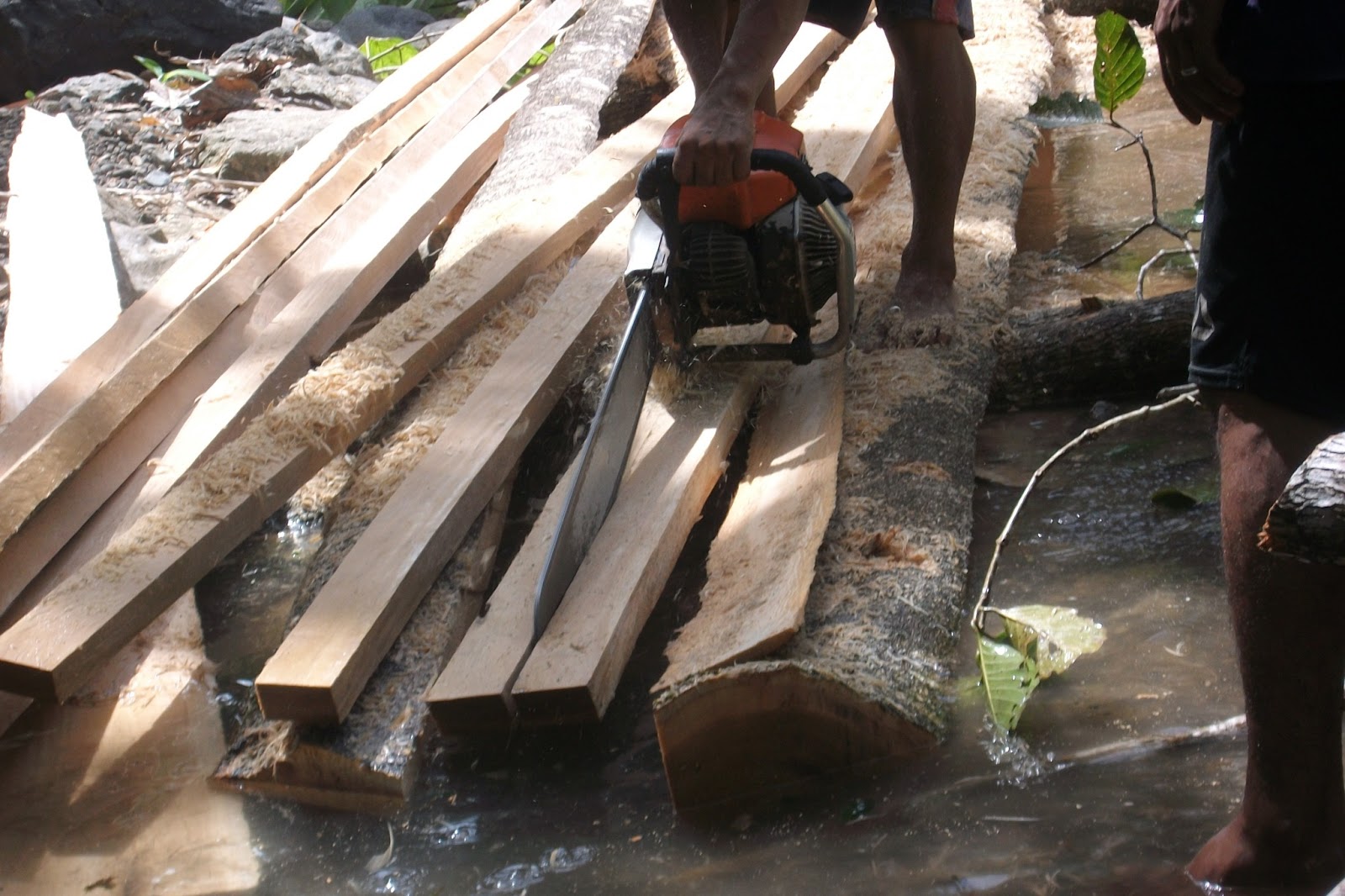
He walks his saw along the log following his straight- line to flatten one side,
removing the least possible material. Then, the log is rolled flat-side down, 
and another straight-line mark allows him to square-off one corner.

The squared log is string-lined to cut 3-inch and 2-inch slabs, and it will then
be rolled  to cut slabs into lumber.  He leaves some "Siamese" places joined in
each cut, to be separated at the end of the process.  Maker's name is worn off 
the saw case but it looks like a REAL BIG Stihl or "Husky", 7 inch wide x 40+
inch long saw  bar.  He is beyond "expert" to "artist" operator.

Shows the log nearly finished into lumber. There are other horizontal cuts
below the picture-edge; he's cutting more than one "set" of pieces.

Well, the pieces are cut; he still has all his toes; the remaining slats will be cut
 as usefully as possible.  This is one of several trees cut in about 4 or 5 hours.

I just had to show you the string-line.  Made from an oil bottle, a fishing
 line,a hand-made crank for winding the string, and uses oil, not chalk.

The lumber arrives at our house aboard a motor-"tricycle," standard small-
hauler in the  Philippines (more on these in another post, soon).  There is
 a stack of table-slabs on top; mostly 8, 10, and 12- foot lumber, but also
six  16-footers.  The entire stack cost about $80 U.S.

The table-slabs were cut from a species prized for this purpose; all very even
and parallel on both sides.  A very impressive feat.  No need for a sawmill here.

Well, I have more to say about materials and the beginning of construction, but this seems to be about the usual length for one of my posts.  So I'll stop for now and get back to you later with other "differences" about how things are done, here. 

PROCESSES - how things are planned and made to happen - always interest me.  And, once you see a few samples of scenery you pretty much know what it all looks like.  I'll work "scenery" photos in fairly often, and try not to go "over-BOARD" on the process photos (or, you might be bored).  But you can expect to see some photos of differences in vehicles (from USA), market and grocery-buying, farming and several other  topics where the folks here adapt to their surroundings, which are different from KY, U.S.A.

Have a great day - -   TeeJay

Wednesday, January 9, 2013

Holidays in the Philippines


   I have been trying to organize my photos into categories so that I can put up blogs by topic: Transportation, Farming, Shopping and Food, Fishing and Local Industries, and so on.  But I'm having a hard time getting all the photos I want of any one topic put together - - sometimes I'm just not ready with the camera when the opportunity comes up.  So maybe the photo selections will be a little bit more random.
   Christmas
in this area is not remarkably different from in the U.S. except for a few things. 
1) Less commercial activity - not all the hoopla of Christmas Sales etc.  We are rural enough here that our small-businesses and the District Market vendors pretty much keep business- as- usual, and the major shopping at San Jose is 40 miles away so we don't have the constant media-blitz of "special sales" that seems to be everywhere in the U.S.
2) Simpler decorations-  Businesses and homes put up cardboard cutouts and streamers, and a few of the wealthier homes have strings of Christmas lights.  Not as elaborate around here as in the U.S.  Noticed more decorations in San Jose; Christmas trees in Malls, salespeople wearing Santa hats and reindeer horns.
3) Lots of carolers-  every evening for a couple weeks, we had several groups of carolers, mostly enthusiastic impromptu "singers" with gourd-rattles and sticks-drumming-tin cans, but several times with guitars, etc.  Some gratuity is hoped- for but not required.  Mostly local traditional carols, mixed with a few familiar U.S. Christmas songs.  Almost always everything sung in 4- count time (we're used to hearing "Silent Night" in 3-count, and "O Holy Night" in 6-count, for example).
  But, Christmas Day was mostly the same. Lots of special cooking, and people going to various relatives' and visiting.  All-in-all a restful and enjoyable day.
  New Year
was most notable because EVERYBODY stays up; most years, lately, I've gone to bed at my regular time. There is some not-quite-superstition that what happens on New Year's Day sets the direction for the year, and maybe for your life.  Some people make it a point to eat spaghetti or pancit:  long noodles = long life, prosperity (pancit is like meat and vegetable stir-fry added to almost any type of long noodle, often "chow mein" or "ramen").  There are a HUGE number of personal fireworks, bottle-rockets,  and other home-made noise-makers (5 or 6 tin cans splinted together into a "gun-barrel" with slats of bamboo and duct-tape; the end of the last can has a pin- hole punched in it; a few drops of alcohol are dripped thru the hole, the barrel is shaken for a few seconds, then a cigarette lighter is held to the hole; makes a BANG! not unlike a small-gauge shotgun).  One of our nearby neighbors treated us to 2 days of Karaoke singing.

Brief Photo Gallery
Some of the orchids grown from grafts, see first blog-post.
Tabasco bushes grow several places on our lot.  Each bush has
hundreds of  inch-and-a-half peppers.  Each pepper is powerful
enough to move an 80,000 pound truck about 10 miles.
How many cats in this photo?  I think 6 but hard to tell. There are 8 around
 here somewhere, and we never see a rodent of any kind.


The row of  8 coconut shell "bowls" as it looks BEFORE and AFTER.
The row of bowls, DURING.
OLD Question: Why did the calf go around the cow?  (To get to the udder side.)
As I've been working on this for a couple days, I've picked up a few more photo's - not enough yet for a TRANSPORTATION issue,but maybe for a short "farming" or "Home Depot" gallery.  But for right now I'll quit for awhile.

Friday, December 21, 2012

Five Weeks in the Philippines

 
Well, I left the last blog entry with the "nipa" house under construction.  It's nearly finished now and is a nice place to hang out in evenings, plus provides a shady place in mid- to late afternoon.  I am always interested in design and construction projects so I will include a few more photo's.  What impresses me most is that this is not some primitive hut but a rather complicated and labor-intensive project which involves quite a lot carefully-cut joints to hold it all together.
The small "tab" on this piece will be fitted into a slot on an upright piece, then
the two pieces will be "pegged" clear through the larger "c"-shaped tab for a
strong, secure joint.
This detail shows how the "nipa" roof-covering is lashed to the rafters.
The front wall is nearly complete, open with "bars" at the top.  Other walls will
be solid, with "c" shaped sections of bamboo nailed vertically overlapping like
 box-and-strip construction.  As of  today, Dec. 22, the walls are mostly complete.
This gives an idea of the spaciousness of the high-pitched roof, and shows some
of the cross-bracing in place.
Sometime in the next few days I'll run the electric wiring out to the "nipa" as we call it, and we will have it finished.
 
At just over five weeks in the Philippines I've pretty well adapted to conditions here.  I'm fairly comfortable as I sit here, and I just noticed I'd not turned on the electric fan.  The humidity seems to be low today, as I'd usually have the fan going because daytime temps are mid-80s.  Things aren't the same here as they were in Kentucky; it would be pointless to move 12,000 miles and then expect to have everything the same.  So I'm getting used to different transportation, different cuisine (it helps that I already like fish), different ways of doing things, and to having my time pretty much be my own. Almost anything I could want in the areas of food, conveniences, etc., is all available. I occasionally do some "American" or "Tex-Mex-Southwest" style cooking.  I will probably air-condition part of the "new" house we're planning. But I'm mostly satisfied with the way things are, and looking forward to some ongoing projects mostly centered around workshop tinkering,  gardening and small live-stock, with all the possibilities that will open for learning how to make sourdough bread, cheese, and all kinds of other naturally wholesome food.
 
I have ideas for some future postings, but I'm just now getting some of the photo's I'll need to share.  I'll try to post fairly soon about how the Christmas and New Year holidays turned out, and later on about marketing and food, transportation, customs and other topics as I begin to notice them.
 
Merry Christmas and Happy New Year 2013!     Tim and Bernadette


Wednesday, December 5, 2012

Arrival in Philippines

This is the first attempt at a blog EVER.  I'm having some trouble understanding how to set up the page etc., and nobody around with experience to help me figure things out.  Hopefully I will get together a script-message at least, and will try to figure out how to include photos.

Much of our first week after arrival in the Philippines went to just trying to get first-level items taken care of.  We spent 3 days on a trip to Iloilo taking care of immigration issues.  The actual bureaucratic work was easily done with very cooperative civil servants,  the major complication being that the Quarantine Doctor was called out-of-office on two apparently complicated field-issues, and not available until mid-afternoon on the second day we were in town; after his 10-minute OK of the paperwork we carried, the rest of the process was fairly easy.  We had used the time meanwhile to go various places around the city seeing what goods and services are available, etc.  Iloilo is more than 300,000 population, so a lot is there available - just not necessarily in the format that homestead-desirous transplants would expect to find.  We will have our work cut out for us if we insist on doing much that is different from how the usual semi-rural folk live here.

The Philippines is a beautiful place to be.  Everything is all shades of green at the moment - you wonder if you've arrived in the Emerald Land from The Wizard of Oz.  I know I'm definitely not in KY anymore.  Looking one direction from the National Highway, all you see is palm trees and beach with ocean in the background.  The other direction, there are more palm trees, usually with some cultivated fields in the foreground and mountains in the background.  Walking inland through rice-fields and then up into some low hills, I arrive at the farmland we own which is hilly but has terraces  covering several acres, and are soon to be cleared and plowed so we can begin raising tomatoes, beans, squash, melons,corn and probably some rice (Bernadette is already starting some herbs in pots, and we have roots on a couple vine-snippets from red-seedless grapes we bought). Once we have the place into production we will begin to acquire some small livestock (chickens and other easy-keepers first), hoping to be as food self-sufficient as possible in a year or two.

A brief description of  just where we are: Malabor Barangay (neighborhood), Tibiao district, Antique (ann-tee-kay like Spanish) Province, on the Island of Panay, Philippines.  If I can figure out how to stick a map on this blog I will. Otherwise, Google Maps pulls us up pretty quickly.  Panay Island is just about in the middle of the Philippine chain, towards the west, and looks roughly equilateral triangular.  We're about halfway up the west coast.  We're 40 miles from San Jose (de Buenavista) Antique, the provincial capitol (100,000+ pop.), and about 100 miles from above-mentioned Iloilo.  A major resort area, Boracay Island, is about 60 miles north of us, and we hope to go check it out when we get a little leisure from settling-in.  Guess that's about it for now.


On the road to the farm.

 
Typical view of farm and property nearby.
 

Comfortable 2 bedroom concrete-block house - hopefully soon to be
duplicated on a lot nearby.


Philippine egg-plant? Nope. Sis-in-law Gina likes to grow orchids, and they are
parasites - grafted into another plant and protected by these shells.


Mostly Photos

In the last blog,I  didn't think to tell you much about the place we're actually living here.  Tibiao (tibby-ow), and almost any place nearby, pulls up easily on Wikipedia.  The municipality seems to cover about 5 or 6 square miles and has a little over 20,000 people.  Quite a number of permanent business are here, mostly street-front convenience stores (seems like about every 50 feet) and the place is large enough to have a 3- day (Tue., Thur., Sat.) "Market" which is a combination of farmers market, flea market, swap meet, food court, butcher, etc. pretty much like you've heard or read about in such partly-rural settings all over the world. Buildings are more and more substantial concrete structures, but still a fair mixture of bamboo-construction is evident. Most people do a mixture of gardening, fishing, larger farming, crafts/ construction, small livestock raising, to make a living however they can.  In the last few years a lot of retirees, both Philipino and foreign, are coming here and building quite large and fancy houses with all conveniences.  OK, OK, I said mostly photos, so here starts the gallery:
                                                                            
I didn't get any coastal/beach scenes in last time.  I see this nearly every day,
looking southwest from Malabor beach to the point at Barbosa, the next settled
 area south of here.
A few steps back, the beach view is more typically framed by trees at the back
or a vacant property, 75 feet from the main road.
This place is medium-fancy; quite a few places are 2-story with balconies, and
multi-room Euro-USA standard,  lots of square footage inside.
 
Meanwhile, the first of several loads of bamboo poles have arrived for building
our "nipa (neepah)" yard-house. We will have something like a "screen-porch"
to relax in the shade or to overnight where it's cooler than the house.
3-foot long palm leaves are folded over slats and stitched in place with long grass-
like fiber, making "nipas" which are tied to the frame for roof- and wall-covering.
Post-hole digger.
 
Upright posts are carefully cut to receive cross-posts (like a post & beam barn).
 
Test fit looks OK.
Pegs split and shaped from large-end bamboo will secure major joints.
 
Detail of upper post and crosspiece corner, pegged together.
Tying sections of nipa onto the rafters.
                                                                            
That's about where the project is for now - roof is a little over half-finished as I type.

I probably won't manade a blog every week - I'm aiming at about one per month, but we'll see how things work out.  I have several ideas for future editions already, but a shortage of photo's (and time) to work on them.  May you each have a blessed day!     Tim Larson,