Thursday, November 2, 2017

All Saints Day ++

(Begun Monday morning, Oct. 30)(Completed  Thursday afternoon, Nov. 2)

October is nearly over, and a flurry of activity around cemeteries reminded me that All Saints Day is approaching, Nov. 1.  In the Philippines, this day is an official holiday and hardly anybody works, in respect for the "departed."  I think that the observation is a fusion of Asian ancestor-respect (often, "worship") and Spanish Christian observance - - and, in fact, in many European cultures, All Saints Day receives much more attention than I ever saw in the USA.  (Halloween, see below *) Here, I made it a point to speak to our mechanic who had scheduled us for Wed., before either of us noticed that it would be Nov. 1, - - and to my surprise he said that he will be working on Wednesday (his "shop" is discreetly behind his house). 


For several days there has been much more than usual activity
and vehicles parked around the nearby cemetery.  Cleaning
up, repainting vaults, and placing of wreaths and other
decorations is in "full swing" much like Memorial Day
is observed in much of the American heartland.
(NOTE: I passed by again on actual Nov. 1 and the crowd
was about 5 times this photo of Oct. 30.  But I didn't have
the camera with me - - -)

 A number of temporary vendors have established near the
 cemetery entrance to help provide the needs of un-departed.
In keeping with my "general rule" of not intruding I didn't go
wandering around snapping photos of cleaning and decorating.
(I mostly avoid putting identifiable pictures of people in this
blog, unless they are known to me.)

*Halloween - - In our immediate area there is no observance
with American type costumes, trick-or-treat, etc.  Some years
the nearby urchins have had wax-candy "fake teeth" and other
SMALL Halloween-motif items which show up in the tiny "sari-
sari" stores, but this year I haven't noticed any so far.  IN THE
LARGER CITIES I see minimal Halloween decorations in
a few places - Christmas decorations have been thick for a
couple months.  In the fairly  upscale shopping malls I see
some costumes and "handout candy" available, so I guess
that the upper-income sub-divisions are beginning to adopt
this American observance as they have done some others.

 The recent typhoons and most heavy-weather events have
"missed us" this year,  but the storms have roiled the ocean
considerably and also the tides are high.  The sand shown 
above is 10 or 15 yards up beyond the  usual "tidal hump,"
where the beach becomes mostly rocky.  The farthest I
have ever seen sand, in 5 years.  The sheer power of the
ocean to move rocks and sand, in millions of tons, has
amazed me.  THIS AFTERNOON the Sulu Sea had its
typical flat-as-a-farm-pond look.

When this lone boatman landed his craft about a minute
after the previous photo, a handful of "meter people" quickly
scampered over to help him push the boat up to the usual
"parking" position.  This, in imitation of their elders, as
it is local custom for anybody nearby to help "land" a
heavily-laden boat.  This small boat, empty, might
not weigh much more than 50 or 60 pounds.  Note 
that the sand, extensive in most places, had for some
reason skipped this little area.

DOOR UPDATE:  "hangin' in there."

The new mahogany panel-door was not quite finished when
I posted last month's allotment, so here I take a moment
to show you how it turned out.  Even with a selection of
power tools to help, there was fully two weeks of two workers'
effort (actually more, I think) to "make from scratch" what
you see.  The center "Celtic braid" carving required two
days to complete, but we are especially pleased with it. 

Cooking occupies more of my attention here, than it ever did in the USA.  Local food is fine, mostly (some notable exceptions), but lots of times I just WANT MORE VARIETY than is usually available here.  VERY BASIC  materials are pretty much available, and MORE items are in the larger cities, but still I have to improvise some of the "from scratch" material in American recipes (Example: green bean casserole, without condensed canned soup or canned French's fried onions - both of which aren't too hard to make from "raw materials.")

I was fairly pleased with this pumpkin bread, which I "baked"
in the Dutch oven on stove-top.  I will repeat it at intervals, for
special occasions.  Banana bread and other sweet breads
would probably work out just as well with the stove-top
method, which uses much less cooking gas than the oven.

The empanadas were a large enough batch (three sheets) 
to use the oven.  They are basically pie-crust "turnovers"
with meat-and vegetable filling. and are similar in lots of
European cultures - many many recipes are on YouTube
and other sources, but I just "winged it" with these: pork,
potato, carrot, green bean, + "gravy."  A small batch can
be done 2-at-a-time in a  dry iron skillet on stove-top.


I've been noticing larger-scale "cooking" in progress at several places along the highway, lately:

Here, tar is being melted in a pot inside a steel-drum fire,
then moved to the large iron "pan" over a trench-fire at right,
and mixed with wheelbarrow-loads of hand-sifted sand.
When it gets to the right consistency, it is shoveled into
buckets and carried to the repair site, where it is care-
fully spread and leveled with "squeegee"-looking metal
hand-rakes.  No fuel-fired trailer-mounted melter-mixer
anywhere in sight!  Everything is hand-work. Even the
firewood is rough piles of branch wood which likely
have to be cut up before they can be used.

The repair site was the approach and deck surface of the
OLD Tibiao river bridge.  The NEWER, larger bridge was
complete in August of 2016, but its approaches have
never been paved so it is not yet used for highway  traffic.
 (LINK  to "Dinosaur" posting, photos of "NEW bridge"
are about # 10 and #11.)
The graveled south approach of the New bridge serves as
the asphalt- cooking site for repairs on the OLD bridge. 
Many locals use the NEW bridge for rice-drying, and I
have used it for driver-training gear-shift-repeat drills. 

One recently- completed project is the "aprons" at the "T"
intersection of Tibiao "main street" with the National Highway.
The areas behind yellow "Slow Down" and red "No Entry"
signs are quite-large aprons which would allow traffic to
easily enter and exit the "T" roadway if they were  finished.
They had river-rubble of mixed stones and sand in-place for
a couple years, which had eroded into ruts mixed with
sharp rock-edges.  We were quite pleased to see the crews
out there pouring the finished cement a few weeks ago.
THIS "couple year old" section has also recently been ex-
tended  at its other end, and the previously-awful 150 yards
or so near the municipal plaza are now nicely concreted.  

(A short distance to the left of this photo is the curve where
the "dinosaur" wrecked, see LINK above, photo #1 in
that Blog posting.)

Not what you'd usually picture in your mind, if someone said 
"Mitsubishi."  Definitely not a Mirage.

The SAME here as in the USA,  placement of cross-walks
and other road markings often doesn't seem to "suit" whoever
is doing the re-painting.  VERY RECENTLY the Highway
Department has gotten automatic paint spraying equipment.
Newer lines are much more regular and precise - Many
times I had seen line-painters working with bucket-paint
and 4- inch rollers, creating wavy lines.

Our church's meeting place is a conference-center which is gradually being developed and improved.  With TWO "camp groups" scheduled in the last week of October, we were able to take a few steps in the right direction as we prepared the venue a couple weeks ago.


The stairs from the food-service area downward towards the
meeting hall and the beach had been many-times patched,
and were no longer reliable for any direction but DOWN
(as in, falling down).

I was pleased one Sunday morning to see that materials
had been delivered for the new stairs.  Note at the top of
the photo, the large object being shoulder-carried is the
Yamaha piano in its case, which weighs nearly 60 pounds.
I can "suitcase" carry it 30 or 40 feet at a time, so I'm
always glad to have younger, stronger help.

On Monday the workers managed to dig and pour foundation,
plus build most of the cement-block walls and risers, for a
nice solid stairway.  I asked them about installing a "zip-line"
down to the ocean (a steep 75 or so yards downward) 
"while we're at it - - "  but I guess that part of the project
is indefinitely postponed.  

Later in the week the finish-work was mostly completed.
Enough material was left-over to do several other repairs
and "extensions" of other steps and walkways.

I have made three San Jose trips plus one "beyond Iloilo" trip in the last few weeks, which is an unusual amount of travelling.  Combined with projects at home and the campground, it's been a busy month.  COMING UP for November, I have probably TWO Iloilo trips and another couple San Jose runs.

This group gathered at Batonan, Culasi, before 7 a.m. one
morning to go to a conference in San Jose. The 50 mile 
trip usually takes about 1 and 3/4 hours, and it is not
unusual for me to have 12 passengers on such runs.
I always watch the overall weight and its distribution
on the car ("old truck driver" habits persist). This day,
"payload" was around 1,700 pounds.  The car has an
unusually strong frame and suspension for its size -
built for cargo! -  which explains its rough-ride when
lightly loaded with just Joseph and me.

Four fairly petite Filipino ladies can ride OK in the back seat.

Later in the day I got this photo.  The guy waving had ridden
in the cargo bed mostly sitting on the tail gate with the other
man there - which is why I always install the cargo straps
when I have passengers.  "Yellow hat" youngster was
in the right front seat with one adult on the early trip.
3 in front seats, 4 in back seat, + 6 in cargo bed.

The longer trip to Iloilo province took place two weeks after the above trip.  This was another overnight trip to Barotac Nuevo, this time with 10 passengers.  The drive time for this 130 mile trip was about 5 hours. 

I've finally learned how to move Google Maps into my Pictures files, so I can
show a map here instead of only providing a link.  Culasi andTibiao are on the
left side of Panay Island, and we travelled south, crossing the mountains
between Hamtic and San Joaquin, then east to Barotac Nuevo, which is
the red outlined area north-east of Iloilo City.

I don't have road-scenes from the most recent Iloilo trip, but
after the conference we spent a couple hours in a large mall
on the outer fringe of town, and I still get a little surprised at
the number of USA chain-stores I see.  I bought a local-
vendor waffle-hotdog snack from one booth, then as I
walked around the next corner munching, I ran into
a Crispy Creme Donut booth - - aw, man! Too late.

Among 4 or 5 rows of kiddie  coin-operated rides, this guy
was prominent in the front.  Wonder if any of the kids here
even know who he is?

We had a rice harvest on a very small parcel (1/8 acre?) recently.
This fish was brought and vended to us that morning, by one
of  "the cousins" who keep us supplied, and the plan was for
some of it to be used to feed the harvest workers (standard
negotiation).  As things turned out, the yield of the small
field was so small that the various "shares" took all of it -
well, we didn't quite LOSE ENTIRELY on the transaction
(the person who planted and tended the crop also paid
for seed and supplies in this case) but we DID end up
feeding the workers and not getting any of the harvest. 
OUR INTEREST is that we have a collateral loan which
gives us first-option to buy the plot, which could be a nice
place for a small residence and personal garden space.

One morning we started working in the front bedroom of
the blue house, getting it ready for an air conditioner unit.
  Constructed about 10 years ago, this is the oldest building
on our town property.  We were pleased to find that the
cement-work and reinforcing are unusually strong, as this
cut out took most of one morning to make.  High-cement-
content mortar was used to smooth and finish the hole.

Finishing our "hole in the wall" plus pulling new wiring
through the ceiling, and re-painting took about one-and-
a-half days.  Still remaining is installing a ceiling fan but
fortunately the existing light fixture is already wired with
an "always on" circuit,  so it will be fairly uncomplicated.
We have added a "moulding frame" around the A/C
since this photo.

SOLID COMFORT: Most beds that I see in use are built
like this one, with a wooden or bamboo frame and slats
for surface, and many people prefer only a blanket or
thin pad under them for sleeping;  foam rubber or other
mattress material holds body-heat and makes them feel
too hot.  We used this bed with a 3-inch foam mattress for 8
months after our arrival, before we got the "yellow house"
built and our Select Comfort air-adjustable mattress 
installed on a practical bed frame.  THIS BED will be
replaced with a Queen size "memory foam" mattress
(We haven't seen Select Comfort in the Philippines yet),
and likely will have a frame with storage drawers under
it, but that part of the project is a little in the future.

My visit to the mechanic on Wednesday was productive, as he was able to repair and modify the carburetor.  There will be one follow up, probably Friday, as he hopes to get a few other needed parts from San Jose on Thursday.  "Vehicle mechanics" other than motorcycle mechanics are few in our area, and Henry is a GIFT with his extensive skills and ability to improvise.  We had to wait for several weeks through his "urgent" projects which were ahead of us, and I am REALLY GLAD NOT to continue driving a manual-shift car with a balky and capricious engine!!  Running pretty sweet, now.

I may have found a way to economize on the number of trips I'll need to make, to Iloilo in November.  I'm hoping to cut back to just ONE, with an overnight stay.  There are some meetings in that area, plus I hope to pick up my replacement "ALIEN CARD" from the Immigration Department.  Several other errands have accumulated, like getting a few months' supply of medicines from a discount pharmacy and getting into the Yamaha Music store for some support services.  We look forward to having a few guests for Thanksgiving Day, and to the Traditional American fare of that day.  

We wish you a pleasant and satisfying "end of 2017," and will be back to you sometime around each change-of-month with another installment.

Have a great day!

TJ and Bernadette Larson
Antique Province, Philippines

I retired to "Ann-tee-kay" Province 4 years and 50 weeks ago, and I'm gradually becoming an Antique.


Tuesday, September 26, 2017

A "Doorable" Wood-crafting

(Begun Mon. morning, Sep. 25, 2017) (Completed Tue. afternoon Sep. 26)


This posting will have more than just the "door project" (mentioned in the title) before I'm finished.  That door is still a work-in-progress, having begun a week ago. So, I may start out with a few "variety mix" photos (HA! I found a new way not to say "miscellaneous" or "etc.").  I tend to forget about scenery photos quite often, but this one was in the middle of this month's "batch" when I looked a few minutes ago.


 On a recent trip to Iloilo, we had left the house at around 4:15 a.m., hoping to slip 
into the "big city" ahead of the morning traffic.  Around 5:20 we were somewhere near Sibalom, and I stopped the car long enough to get this nice sunrise shot.  It's always
a relief on such trips when we begin to have enough sky-light to be able to see objects,
as driving on 2-lane highways in total darkness and trying to "make good progress" (average gain, about 30 to 40 miles in an hour) is nerve-wracking.  

About 45 minutes before this photo, I was squinting my way past the headlights of an on-coming vehicle, bearing to the right edge of the road, and caught a last-instant glimpse of three joggers running towards me on the right side-stripe of the pavement, just as I swooshed past them - - missing them by inches!  There is a contradiction in people who go running for their "health" before daylight, and who run in the "correct" direction for pedestrians, but who have dark clothing and no reflectors.  Ironic, if their "healthy habit" brings about their demise- by- vehicle, scattered like so many bowling pins.  (These days, battery powered L.E.D. strobe lights are readily available, too, and that sort of light would  probably have alerted me to them even with the "blinding" effect of the approaching vehicle.) 


About an hour after sunrise, we had passed through  the mountain-
area between Hamtic and  San Joaquin, and we stopped at our usual
"break" place.  The sign above grabbed my attention, but of course
I didn't "UNDERSTAND????" the local language above the English
conclusion.  A "delicate" translation is that it explains the purpose
of the brand-new urinals in the mens' room by mentioning
what they are NOT to be used for.

(Regular readers may remember earlier mentions of this snack-restaurant stopping place, as for several years I have posted the progress of their "mens' facilities" from primitive "gutter-and-trough" through customized 5-gallon water bottles hand-cut into individual service- units (urinals) and NOW quite recently the "genuine- ceramic real-deal."  There is no real functional difference in the various modes, but it has been interesting to watch the various stages of improvement.)  This place is located about 50 yards. from the "bridge replacement" project recorded in (link)  "Mango Mouth" posting a couple months ago.)

(Looks like I'm side-tracked from the "A Doorable" project in the title, but I'll get back to it sooner or later.)  Seems like, topically, I should finish out the "Iloilo trip" segment first. I haven't figured out yet if there is a way to put a Google Map on this page but I encourage readers to refer to  this link which should show the area of Panay Island from Tibiao at the left passing south to San Jose, crossing the mountainous peninsula between Hamtic and San Joaquin, continuing to Iloilo. This approx. 100 mile trip takes about 3.5  hours if there are no unusual delays.  Unfortunately when we got near Iloilo at around 7:30 a.m. we ran into gridlock traffic and the last few kilometers "in town" took us nearly another 2 hours to negotiate.  


The FIRST errand at Iloilo was stopping at Bureau of Immigration for some routine business.  (I needed to renew my "Alien card." So far I haven't gotten my space-craft certification - - )  


AFTER that we were finally able to go looking for a membership store we had heard about for several months ("Costco/ Sam's Club" type).  We found quite many goods which simply ARE NOT AVAILABLE in this region, in any usual vendor situation.  Prices generally seemed to be "within reason" considering the 10,000-mile-plus supply distance.  Dill pickles and pickled jalapenos (photos) are rare;  fresh mozzarella cheese and Tillamook sharp cheddar are unheard of; a bakery-style fresh strawberry-rhubarb pie (!!!),  also unheard of, was among 6 or 8 varieties offered.  An 18-inch combo- pizza also rode home with us.  (LARGE size pizza here is often 12- inch and never more than 14- inch.)  We will make a point of "stocking up" on a few luxuries whenever we (or any friend) travels to Iloilo.  (The pie: quite good filling with fruit, not flavored cornstarch; acceptable but somewhat "heavy" machine-made crust.)


That membership store - "S&R" - is of such great interest to us BECAUSE of the rarity of such businesses and their goods.  This chain store now seems to have units in quite a few large Philippine cities (from their online web site). 

This ultra-modern building with cobalt-blue glass exterior is
about 30 miles north of Iloilo at Barotoc Nuevo municipality.
Situated among mostly barren farm fields, it is impressive
and beautiful, but seems "way far" out of place, as though
it had been dropped there from an alien environment.  It
is the new Municipal Hall, replacing a more-traditional
building "in town" which had no space for needed additions. 

An apartment building in Barotoc Nuevo features statuettes of
all seven dwarfs (I think) and Snow White, plus a couple
unicorns and what looks like an elephant. 

 Returning home a day later, we noticed that these quite-
elaborate sunburst- pattern fences are being installed for
more than a mile on both sides of the main highway, in
one "barangay" (neighborhood*).  This is an expensive project
for this place!  The work is in-progress but it is already 
apparent that the completed effect will be impressive.

*"Barangay" is the Philippines' smallest official governed area
with "mayor" and "council members" but the titles of those positions are different here.

This imposing domed structure has also caught my eye
many times in-passing.  It is located in a cemetery about
25 miles west of Iloilo.   The type of building is just not
usual for this place, looking more like Indian or perhaps
Southeast- Asian mainland.  That entire cemetery is
generally ornate, compared to the plain- cement above-
ground vaults which are most common around here.


We passed through Sibalom in early afternoon with heavy
rain-clouds gathering above us, and this freshly painted
church building was so intensely pink that  it seemed to
be radiating energy.  The camera can't quite capture the
effect of the light, but there is a "suggestion" of it.

If you use the map link above, you might have to zoom-in 
one "click" to see Sibalom, east of San Jose.  I couldn't
get the link to cooperate very well when I was setting it up.
We frequently travel from Hamtic to Sibalom in a straight
line, bypassing San Jose and saving 30 or 40 minutes.
This road is in good condition, and remote, so we can run
85-95 for about 10 kilometers. (That's around 55 to 60
miles per hour, unusual to sustain that speed here for
more than about a minute anywhere.)


The "highlight" project of this past week has been making a new door for the "yellow house," which we built on the property here in town in "months 2 through 9" of our first year  in the Philippines.


We moved into the nearly completed house on July 4, 2013,
and this flat- door has served us for 4- plus years.  Soon
after we got settled, I found time to paint the 4-panels
illusion so that the door wouldn't look so plain.   (45
years ago I spent a couple years in the junior college
theater department, and learned odds 'n' ends about
painting and heavy electrical work, among other things - - -)

This mahogany frame-and-panel "front door"  is on our older
"blue house."  Its motif is fairly common here, and served as a
model for the new-door project.   Doors like this can be bought
made-to-order at local woodworking shops, and cost around
$350 to $400.  But, we have the materials, tools, and brother-
in-law Alex's expertise to make our own door.

Typhoon Yolanda** (international name Haiyan) of November
2013 knocked down some trees on our farm-property, from
which we made slab- wood which has been "curing" since
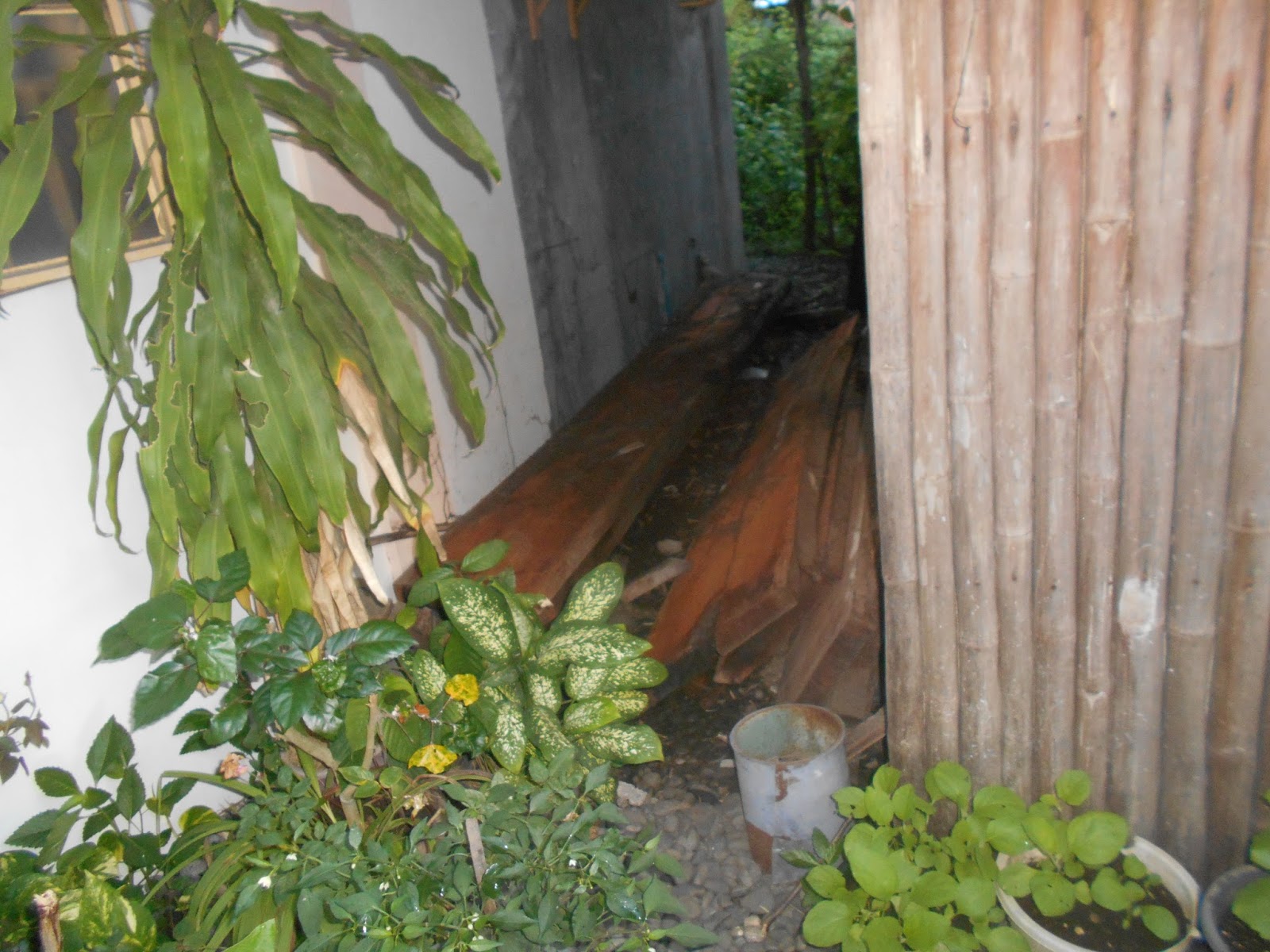
then.  These slab piles were nearly 4-feet tall on both sides
of the area above, and we have had a lot of fine items made
from them.  The new door, in progress for a week now, has
required two of the slabs.

**(I have this "anti-" thing about useless government functions,
and I haven't yet seen the value of this country adopting
its own set of names for typhoons, which are different from
the common international names, creating confusion.)


 The first tree-slab was cut into planks the correct width
for various frame-pieces of the door, about 5- inches
to 7- inches finished size.  About 2 days of planing and
other shaping got them straight and smooth on all 4 of
their sides.  Above, the horizontal frame pieces have had
tenons ("tabs" which will insert into "slots") carefully
cut onto each end.


 Meanwhile, the vertical frame-rails have carefully- measured
mortises ("slots") cut by first drilling holes and then precisely
chiseling out excess material.  Mortise- and- tenon joints
will be glued together in final assembly, with the panels
resting in grooves cut into the heavier frame pieces.

 Here the door's frame has been test-assembled to be sure
everything fits OK.  No grooves are cut in the inside of the
panel spaces yet.   It will be taken apart and the panels
and grooves will be made and fitted before final assembly.


We didn't have any bar- clamps which are used to pull the
tightly- fit pieces together.  So, one afternoon we made a
"materials run" to Culasi (15 miles) and bought some nice
new 6- inch "C" clamps, and the next morning Alex cut
them in half and welded them onto angle- iron extensions;
the new clamps will be generally useful for other projects.


The next task was to load the second tree-slab onto the Suzi
and take it to a nearby wood-worker's shop.  It is 2-1/2 inches
thick and  we must have door-panels half that thickness.


 The sawyer stood the thick slab on its edge, held off the floor
by a couple wood blocks, and free-hand began to make a
straight, on-center groove in its edge with his 42-inch bar
Stihl (Swedish I think) chain saw.


 As the groove became longer, he casually stepped up onto
the plank, handling the big saw as easily as Aunt Bea would
slice a roast with her Rival-brand electric carving knife.
Notice his personal protective gear.  (NOT!)  Middle- 30s
age, he probably has around 20 years experience with
that saw,  and still has no scars, and no missing parts - - -

 This view-point shows that the only thing holding the plank
upright on its edge, is his helper standing on a 2x4.  He
walked forward allowing the saw to make a groove maybe
6- inches deep - - - - then walked backward, letting that
groove guide the saw bar as he plunge-cut through the
rest of the width of the plank.  If anyone around here ever
"hoists the Jolly Roger" he will have plenty of practice
walking the plank.


Back at the starting point, he stepped down and made his
final cut to separate the two panels he had created.  All
"gasoline" fuels here are 10% ethanol, so that is what's
powering the saw.  But I note that at the top of the photo
on a nearby bench is the 40% ethanol which may be
fueling some of the humans..

The whole process seemed to take about 5 minutes - - but
I suppose it could have been longer.  The sharp, coarse
saw teeth passed through the tough mahogany effortlessly,
and left a flat surface which will need minimal smoothing
to become finished door- panels.

We agreed on a "Celtic weave" pattern for the carving on
the waist-panel of the door, as being simpler and more 
boldly graphic than the "floral plus feathers (?)" carving on
the "sample" door.  I spent a little while trying to manually
enlarge the pattern from an "Image: " Google search-result,
and another little while trying to teach myself how to work
with the graphics programs in my computer here; but I
ended by going to one of the many internet-cafe/ printing
shops around the nearby University of Antique, where 
the owner was able to quickly produce the correct-
size template of the pattern for us to paste on the "blank"
panel and carve.  We're debating whether to add some
carved-grooves to the weave pattern so that it will
look more like rope.

So at this moment the door is again test-assembled withall
panels except the carved waistline.  It has a total of 5 panels
instead of 7 panels, again for simplicity.  This detail shows
the beveling of the panels and the grooves which will hold
the remaining panel in place.  The door should be finished
and hung in place in the next few days.  The "old" door
will be re-used in another project.


Projects are done, and things are made here, quite differently than they are in the USA.  Several-year readers of this BLOG may remember some of the postings from 2013 and 2014 in which I covered a lot about methods used here, and worked a lot of "cultural" comparison in-between.  I encourage more-recent readers to skim back through some of the previous when you get a few minutes, as I try not to be too repetitive in things that I present. (Archive- navigation links at top- right side of this page)


Seems like I may not have space this issue to show some of the other "busy- ness" which has been happening the last few weeks; "saving the microwave," baking pumpkin bread, doing preventive maintenance on Suzi, and beginning renovations on a "guest room," among others,  But I think I WILL put up a couple "interesting things seen" items:


In 2013 we didn't have the Suzi  but we were frequently going
to and from San Jose by van and bus.  One afternoon our
van had to brake HARD, when we encountered this flock
of ducks and geese after a curve in the road.  They were
walking along in a very orderly fashion, just BLOCKING things.

 Last week we encountered their grand-children (likely) being
transported in this custom-made 2-deck trailer, pulled by a
motorcycle/ tricycle.  A dozen attempts only got us this photo
of the trailer but not the motorcycle (moving vehicles).  The
ducks' owners are from nearby, and they arrange for their
flock to spend several days at a time in newly harvested
rice fields, gleaning fallen grain and insects from among
the stubble and mud.  (LINK, "tricycle" posting)

"Manila Disaster Risk Reduction and Management Council"
seems to be the "MDRRMC" governmental department which
posted this sign on the National Highway somewhere between
Tibiao and San Jose.  It certainly gets right to its point with no
words "minced."  Reminded me of one of my favorite short videos: 
a one- minute "play time."  ENJOY!


As usual, there are some topics and photos I didn't get into this posting.  And, looking at the "preview page" I found that there are some formatting problems especially around the small side-by-side photo area.  I think I'm just going to let those go, as most times when I try to re-edit, "RESISTANCE is FUTILE!!" 

Enjoy your "entry into Autumn" wheerever you are.  It's a great time of year!

TJ and Bernadette Larson,  
Antique Province, Philippines.