Monday, May 5, 2014

Hostile Takeover

A "hostile takeover" in business usually involves a high-powered businessman - a tycoon.  In our little world of Antique Province, Philippines, the hostile takeover of November 8, 2013 was embodied in a typhoon.  Typhoon Yolanda (apparently called "Haiyan" everywhere outside the Philippines, go figure) and its aftermath literally took over peoples' lives in this area for four or five  months (and it certainly was not friendly).  Some of the specific after-effects will continue for several years.

It was one of the strongest, most deadly tropical cyclones ever recorded.  More than 6,200 people perished in the Philippines; I don't know the numbers for other places. The wind-speeds were given as high as 165 and 170 miles-per-hour at landfall; fortunately for us, landfall was several islands and a few hundred miles to the east of us, with the storm moving westward over the central "Visayan" islands of the Philippines. We got the last of it, being the farthest west, but we were right under the middle where we caught everything there was to catch, and that was plenty.  "Just like in the books," we first had two-plus hours of incredible winds from one direction (north) as the storm moved in from the east; then nearly two hours of complete calm as the "eye" passed over us;  then two-plus hours of wind from the south as the counter-clockwise rotation of the storm passed its trailing edge in the opposite direction.  I have experienced 75- to 80- mph winds a number of times, and this wind was by far stronger than anything I could have imagined.  We were very blessed to have it ALL in daylight; the passage here was between about noon and 5:30 p.m.  The confusion, fright and panic would have been much worse at night-time.

My regular readers already know we had no harm and very little damage.  We're grateful for that, but sad to see the amount of damage to the homes of "the poorest of the poor" nearby.  We saw none of the subsequent news coverage of photos and videos and heard no news reports - our communications cable was taken out by the storm, and is only now restored for about a week, after 24+ weeks without TV or internet service.  One local radio "talk + news" program was available on our battery- portable radios for several hours each morning, but its broadcast is in the local language so I didn't "get", much of it.  All of you have probably seen lots more than I did, but I will put up some of the photos I took especially looking at "before" and "after" plus some of the odd or ironic things that struck me at the time. 


   Here's a typical view of our street as seen from the main highway.
The elementary school roof is visible at the far end, about 100
meters from the intersection.  The banged-up corner of the bus 
stop in upper left serves as reference point for the next photo.


The morning after the typhoon, as seen from about the same point.


Halfway along the street, looking left from our gate towards
the school.


 As the eye of the storm passed in mid- afternoon, several
hundred people rushed to take shelter at the school.  Many
more joined them when the second "blow" ended at 5:30 p.m.

 In the confusion, one tiny flip-flop dropped from its owner's foot;
perhaps recovered later, perhaps not.
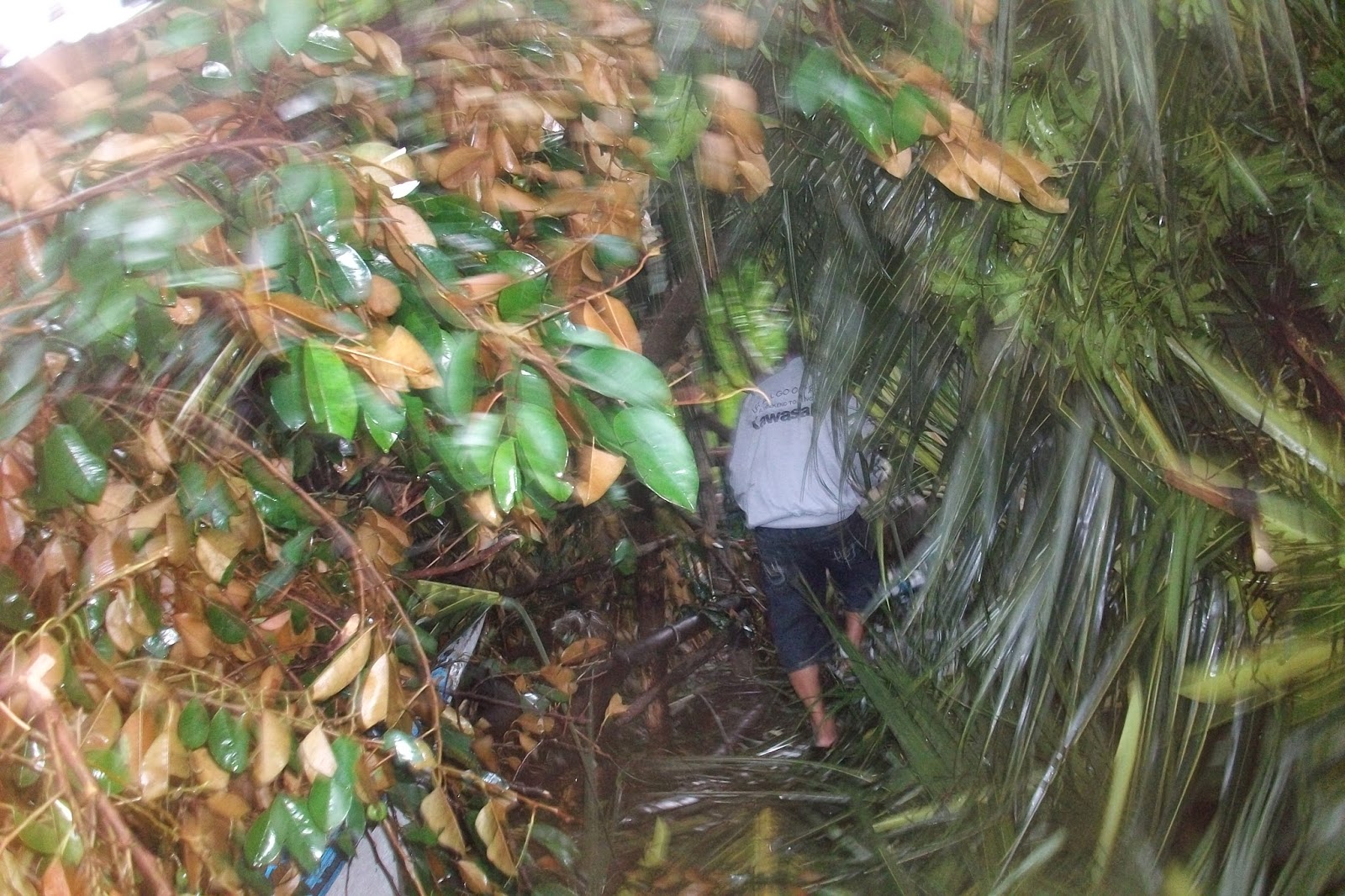
A "leaf tunnel" where the only passage through the street was
where the top of the tree rested against the opposite-side fence.
Approaching the school, that's the neighbor's carport leaning
where it was blown across the street into a fence.
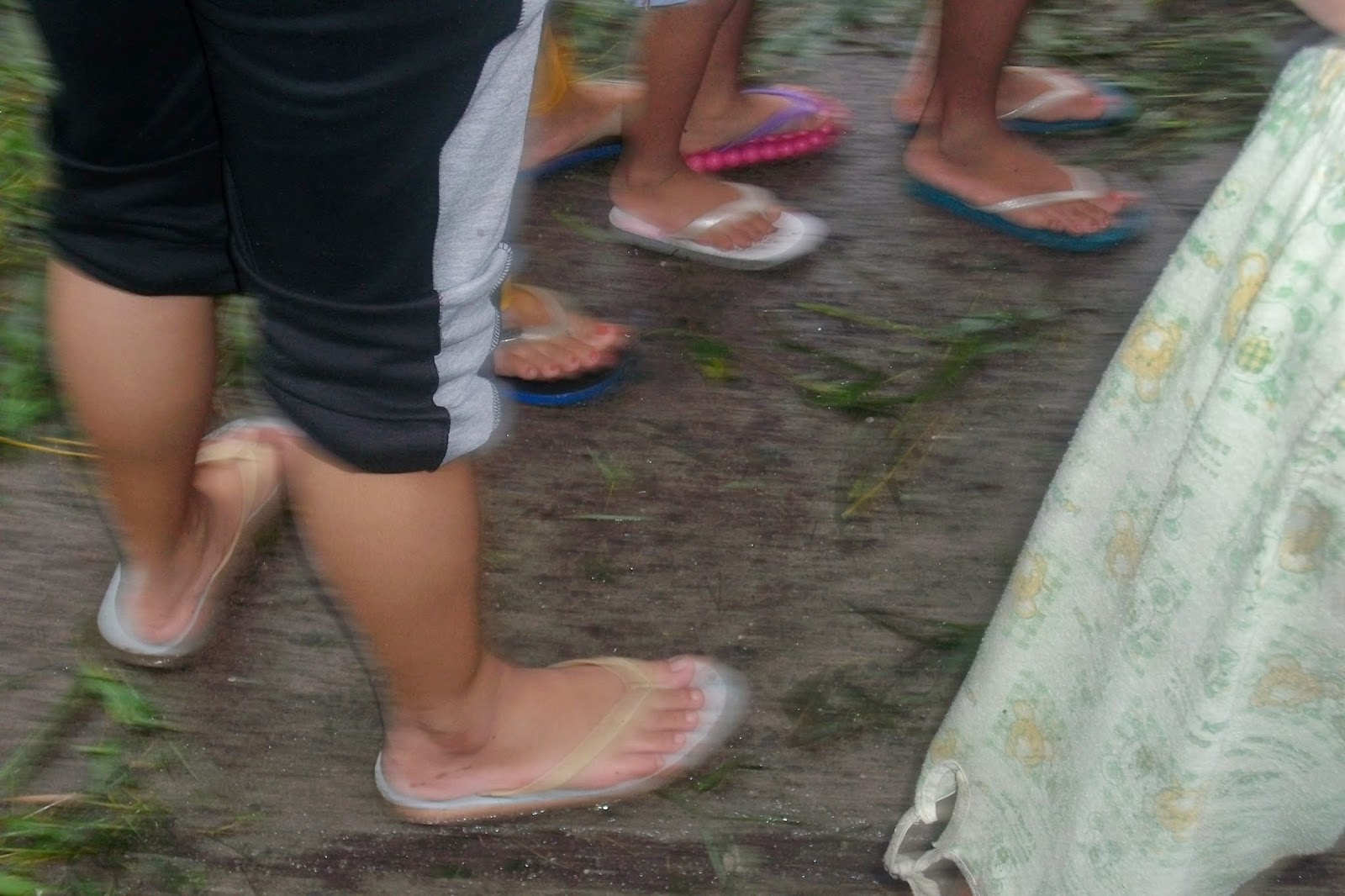
In weeks and months following, this was a common scene;
people waiting in line for distributed "necessities."


The school was in fair shape: Some roof damage but far better than the area surrounding our mostly-concrete-house street.  Several hundred people camped out there for more than a month as they struggled to build any sort of structure to replace houses.  Relief supplies and media coverage to our area were pretty scant for several weeks; the outside world's attention was mostly directed towards the east side of the islands, where all the crews had gone before the storm in anticipation of its landfall.


Meantime, out in the neighborhood, things were pretty rough
all over.  The concrete walls remaining are the bathroom of
one house at the back end of my in-laws' family compound.
The canoe may have been placed against the tree keep 
from blowing away; or maybe the storm put it there.
This little picket-fenced cottage had been just behind the house
in the previous photo.  Always very trim and well-kept, before.

After, the only way I'm sure it's the same place is that the
canoe is barely visible leaning against the tree at right.
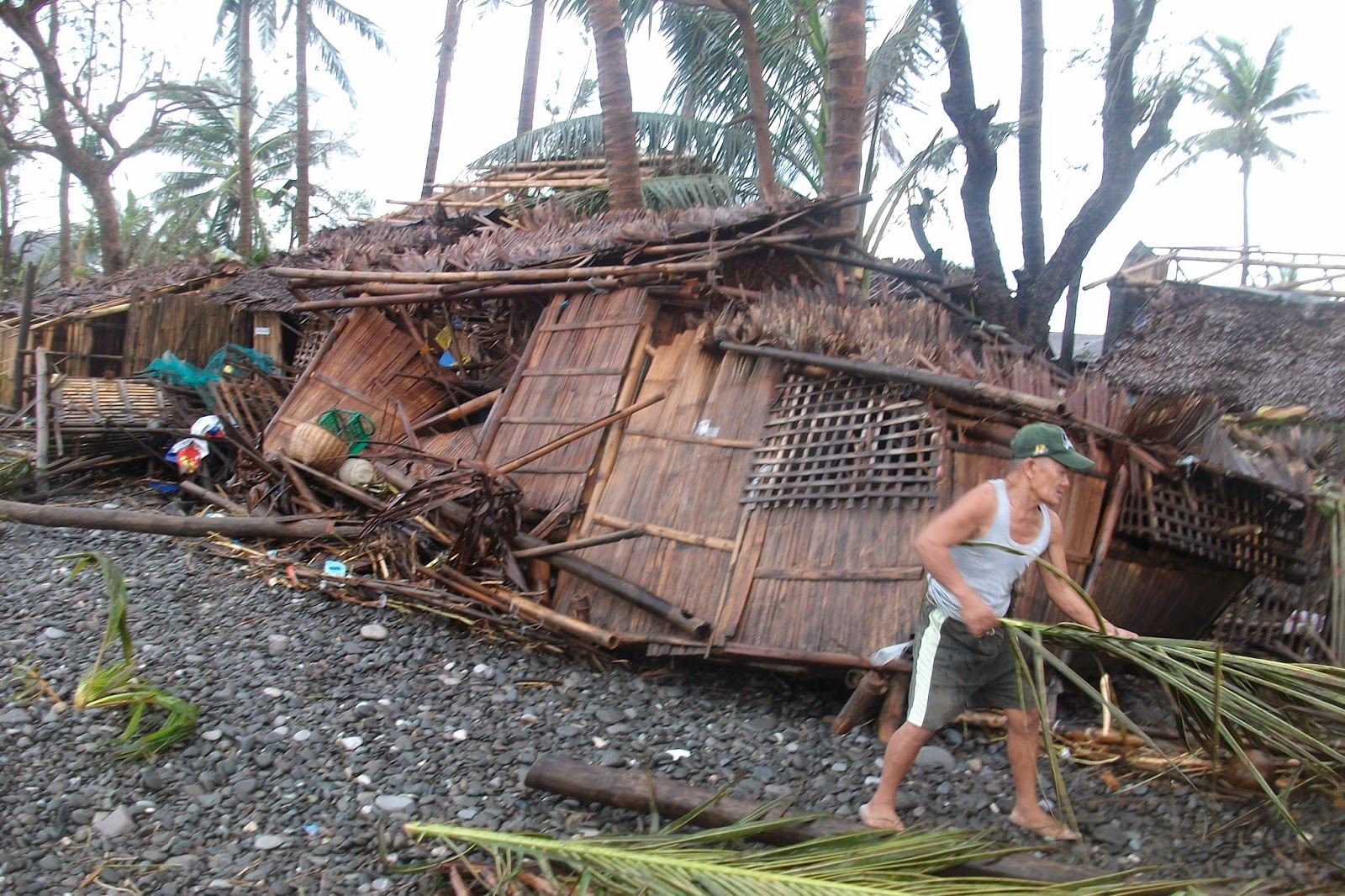
A few steps away, one of Bernadette's uncles is clearing
debris away from his place.  The panels of this house, and
others, were straightened and re-used when possible.
One odd little thing I noticed was this pair of shoes which
were still hanging there, after nearly everything else was gone.
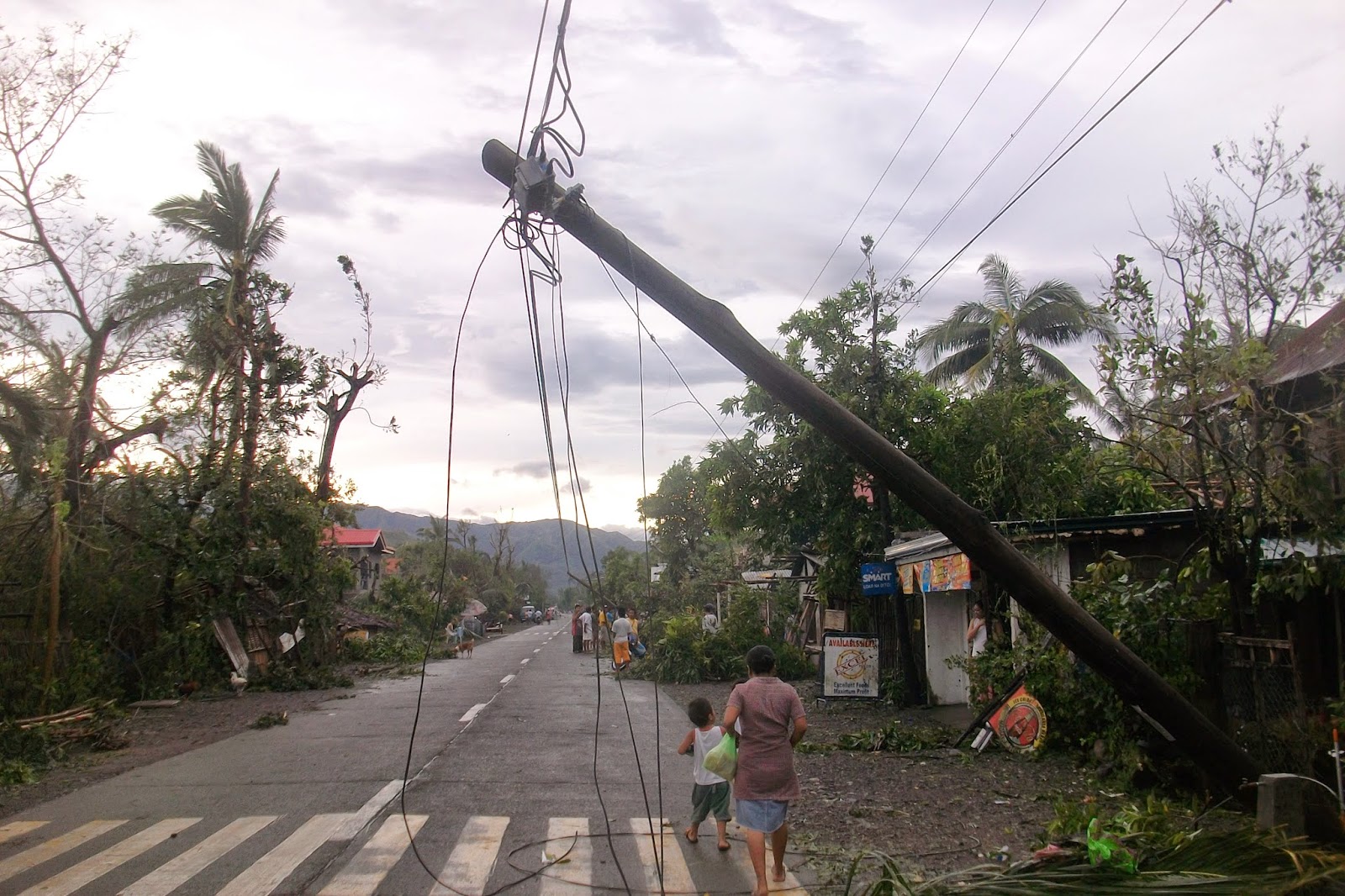
Out on the main road, utility poles and wires were everywhere
for the first 2 or 3 days.  No worry about handling the wires during
cleanup;  there was no electricity for 3 weeks!
Calm after the storm:  Mother hen bosses the chicks as usual.
Several canoes are parked along the road at top - moved
before the storm to keep them from blowing or washing away.


 Everybody helped to try to regain "normal" in the days after the storm.
This place is on the east side of the main road.  It fared no better
than more-exposed places on the "beach" side, to the west.
 "Morning after" yard cleanup at our place.  Yesterday, the thicket of
bean and squash vines plus a papaya tree was so dense you
couldn't have seen the house door from here. Now, they're GONE!
But what remained, a few feet away, was this spray of tiny
orchids, entirely undamaged; another of "many odd little things."


Electricity being out for three weeks went beyond inconvenience to hardship in my opinion.  In this climate of high temperature and very high humidity, there just is not enough absorption "margin" for a foreigner's body to cool itself - - the air is already too "wet" to wick away perspiration - - the body cannot cool itself - - and you feel like you're literally in a slow-cooker.  I "adapt" by staying close to an electric fan whenever possible, otherwise I quickly begin to overheat and heat stroke would be a possibility.  I carried a sprayer bottle, kept wet with water fairly often, and did anything I could to keep cooled down.  At night I think EVERYONE was waking up with the bed soaked with sweat, and nothing to do about it. I would get the battery- LED light and read for awhile, then try to get some sleep - - but little success.
 At the end of 3 weeks we sure were glad to see this guy arrive one
Friday.  Here, he's using a fiberglass pole with a hook - -
to seat our service line in the split at the top of a bamboo post we
provided.  From this post, at the highway corner, he stretched the wire - -
to a tree near the corner of our property, and a few minutes
later, we were hooked up!   Hurray!

Well, I have lots more photos of the aftermath and rebuilding from several months of activity since the typhoon.  I'll continue the story next time, but probably will do some shorter topical "segments" in blogs instead of keeping each post on one topic.  Lots has happened - -

We are very blessed to have never missed a meal, to have only slight damage, to have always had cooking gas and other means for preparing our food;  we have learned to notice our blessings a little better than we did before.  We are relieved to finally have cable reconnected, as it is our most reliable means of contact with any place beyond our immediate area.

We wish all of you the best - a Happy and Prosperous 2014 - 

Tim and Bernadette Larson,   Antique Province, Philippines

Friday, October 25, 2013

Rice is Nice (1)

Rice is the foundation of most people's diet in this area, and I am fairly certain in most of the Philippines.  In the last posting, I began with a similar statement about FISH.  There's not a contradiction, as these two ingredients certainly make up a large portion of the volume, and the calorie content, of the traditional eating-habit here.The largest-volume item is rice; followed by cooked greens and vegetables (carrots, squash, potato, eggplant), fish, local fruits (papaya,banana,coconut, pineapple, mango and many not heard of in the USA), and on "special" occasions chicken, pork or beef.  There are a fair number of possible ingredients, but it is the rice which "holds it all together."
   As I begin to write this on a Monday, it appears that a large portion of our activities this week will be concerned with producing rice on TWO field locations which we are currently trying to farm.  Today, a group of 17 "hired hands" is gathering and transplanting seedling rice in the field-area we recently acquired use of, as it is now strong enough to allow for this - a "routine" task which distributes the rice evenly and efficiently in the field, as simple  "seed-scattering" could not do.  Bernadette and one niece have spent most of the morning preparing the large meal for the crew, which was taken to them around Noon.  And on Wednesday we are scheduled to cut and thresh the rice from our farm property which was planted in mid-July.
   The plowing and planting I wrote of in "Filipino Pharm," which  was posted about four issues back at the end of July. Here, I hope to describe the rest of the rice-process from harvesting and threshing through drying and machine-polishing.

Just after morning break time, the workers are heading back into the
fields; the bundling, moving, and transplanting of the seedlings to cover
the field evenly is pretty much the same as described in my earlier posting.
The difference between locations is that this "flat-land" field is a much
larger space, and receives enough water through the year so that it
can produce three rice crops.  The "Farm" can produce one crop of rice,
and then another crop of vegetables, etc. which don't require flooding.
"Meanwhile, back at the house . . ." the kitchen crew prepares the
lunch meal.  A large iron re-bar "trivet" makes it possible to put
fire under pots which are 3- to 4- gallon or larger.

During the workers' afternoon break, Bernadette tried her hand at
planting some seedlings for a few minutes.  She said she used to do
it for pay, but  the last time was 1973 or 1974.  Each seedling
is about 12- inches long, and has about a dozen grasslike blades.
The purpose of the transplanting is to distribute the rice plants evenly
on about 6- to 8- inch spread pattern, where they will grow strongly
and produce the maximum amount of grain.  We had an excess of
"scatter seeded" transplants, even though the portion of the field
they grew was quite small - scatter seeding places them too closely.
This crop should now mature in 90 days - about Jan. 20, 2014.
 
The mark of a rice field worker is gray-brown "knee socks."  They
wash off pretty easily.
Brief refresher: Use the archive-list (if you have an extra minute) at the upper-right of the page, to take a quick look at  the "Pharm" posting from the end of July.

  This photo is about 2 or 3 weeks  after the transplanting which I
featured in "Pharm," and the rice is growing and filling in nicely.  The
Passion-fruit in the foreground are tennis- ball sized.
 
The same place 3 weeks later; the water bottle is a 12 ounce, so the
rice is about 24- inches.  For another 6 to 8 weeks it will grow thicker
and set its grain heads, until this week, late in October - HARVEST!
This is not a pharmacy - - more like a "farmacy." We would like to grow
"all natural heritage type" rice,but it will take us a while to "wiggle over" in
that direction.  Almost EVERYTHING grown here is some type of high-
performance hybrid, which requires fairly intense and specific chemical
feeding (fertilizer) and insect-protection.  This short shelf in the a local
Ag- supply store is just a little sample of what may be needed to farm.

The crop looked pretty good on harvest morning.  The leaf in the
center of this photo was 3/4 inch wide, to give you an idea of sizes.
The 6- to 8- inch seed heads are considered "good" if they have
upwards of 200 grains; two that we counted were 267 and 300+.

The harvesters are each given an area of field to cut, and work their
way across in arm's-length swaths.  The rice knife is like a smallish
sickle, about 9-inches, slightly larger than a dinner plate. 
 Each  armload is cut a few inches below the seedheads, and laid in a
row to be easy to pick up and move the the threshing area.

By lunch-time, the harvesting is done and each reaper has moved his
cut rice to the threshing area; each worker's pile is separate, and the
amount each one cut will be used to figure out the "shares" he gets
.The arrival of the thresher is not unlike the Ark of the Covenant - it
is carried by poles, on shoulders.  Before the cover is put in place,
the working parts are displayed.  Rice stalks are pushed in on the far-
right side;  the long "comb teeth" rotating will grab and force them through
the "grills" below, also moving them to the left.  Just above the pulley, there
are flat paddles rotating which throw the lightweight stalks up and out the
discharge chute, lower left.  Grain and husks drop out the bottom.
To the right, and down from, the pulley in the previous photo, this
full- width housing holds a three-paddle blower which spins rapidly
providing a lot of "wind" to blow stalks and chaff out of the machine.
The 12- horsepower heavy diesel engine arrives in the same manner
as the machine's cabinet.  It will be installed in about 5 minutes.  The
heavy fly-wheel visible is about like a 50- pound barbell weight; its
spinning momentum helps the engine to crush its way through the stalks.
(MENTAL NOTE: I have some ideas of using a 16- inch pulley to
cast a cement flywheel, to help power pedal- or- treadle machines like
grain mills, scroll saws, meat grinders, etc.)
Set up and running, the crew rapidly pushes stalks through the "works."
The blur in the upper right corner is stalks being thrown 30-  to 50-
feet beyond the machine.
Heavier grains fall directly below the machine.  Grain with excessive
straw and husk is blown further away, under where the hoe is. Some
difference in color is noticeable - more greenish grain has more chaff in it.

It takes a hoe-man, a basket-man and two baggers to keep up with
the flow of the best, heaviest grain.
 
 (Not shown:) On the fringes of the threshing mat the "cull" rice (lighter-weight husk-
laden grains) was picked up (gleaned) by several people. They and their families will
put this in water, skimming off whatever doesn't settle to the bottom; the heavier
grains that settle will be dried and processed.  Much effort produces at least a little
rice for them to eat.
After the threshing and bagging came a part of the process I wasn't expecting -
so I learned something new!  The thresher crew had also brought a 4- horsepower
large-blade fan and this "tipi" style platform and sieve.  Only the best grain threshed
was passed up to the platform to be dumped through the sieve and winnowed one
more time.  This assures that the final raw rice grain - called "palay" -  has
the highest possible percentage of actual usable rice in it.
This shows the fan blowing most of the remaining "chaff" from the rice
which will be stored and dried for final polishing.  At the edge of the
winnowing mat there was more gleaning, and later when the mat was
rolled up the area was thoroughly picked over. It makes sense that
THIS rice would have higher quality "culls" than the earlier threshed rice.

ANY conventional farm tractor is a surprise to see around here.  This one
was used to bring all the threshing equipment out to us.  The driver named
the manufacturer - three initials that I didn't "get" - but explained that the
maker is Isuzu.  Except for minor details it is very similar to the 1960s
Massey Ferguson I had the last several years in Kentucky.

The driver made a very nice reverse-three-point turnaround, and off
they went.  When we left a short time later we found the crew setting
up to thresh again about 300 m.  down the road from us.

I'll save the drying and polishing of the rice for some other time.  I've cut a few photos from the above and condensed what I wrote, and I'm hoping that it is still clear and understandable.  As things turned out, "nice-looking seed-heads" isn't the determining factor for a crop of rice (fourth photo after "refresher", above).  They also need to have solid, mature grain kernels in them.  Despite our efforts, a combination of insect damage and immature kernels caused our net harvest to be one-third to one-half less than it might have been.  So this time the rice cropping process was an educational experience, and we learned several things which may come in handy to know as we continue small- farming.  We "wholesaled" the freshly harvested palay rice the following day, as the amount of labor and time to sun-dry it and the cost of having it machine-polished didn't seem worthwhile to us, for this time around.  Another time, a different crop, maybe different results.

The next issue may have views of some other occupations I've seen nearby.  I've also found a few "misplaced" photos of some aspects of earlier topics, which I'll post from time to time.

Meantime, we hope you all have a great weekend!

Tim and Bernadette Larson,  Philippines


Sunday, September 29, 2013

Boats and Fish

Fish is an essential, staple food for most people who live in our area.  It is the most readily available "meat" for most people, because either they can get it for themselves or it is about one-half the cost of chicken, which is the next- cheapest.  In our household I have not yet seen a day when fish wasn't part of at least two meals.
The population of the Philippines is mostly distributed in areas of the best available resources - water and food being primary needs; this is no different from any other place in the world which I have observed.  So, no surprise:  a glance at the map of Panay Island shows most of the place-names lining the perimeter of the land, with various other settlements located along rivers which flow from the interior of the island.  (I recommend looking at Google Maps.)  Small-scale fishing - one or two people in a canoe, several canoes cooperating, or cooperative raft-fishing seems to feed a majority of the folks here.  I've been making photos as I walk near the sea every day, and am finally getting around to show you some of what I've seen.  (The preferred word locally seems to be "boat," not "canoe" so I'll start saving keystrokes now.)

 The boats in this area seem to be mostly two general sizes.  The
smaller one here is about 12 feet long and 16 inches deep;  the 
larger one is about 16 feet long and 22 inches deep.  These sizes
are approximate; each boat is a hand-built individual.  Every one made
here has the "swan-neck" at each end.  Out-rigger float frames are
aluminum electrical conduit and floats are bamboo sections. The
blue color is a "factory stock" paint here and is seen everywhere.
Boats line the beach here, just above the "hump" of the high-tide
line - there are few gaps in the lineup for as far as you can see.
Here, one boat has just returned from early morning fishing;
they often go out at 2 or 3 o'clock a.m.   Long shadows
pointing west suggest this  may be 7 a.m. or so.
 I don't know the particulars of the fish business.  I imagine that a fisher
will feed his family first, and then will have certain regular agreements with
others who either buy to eat or to re-sell. 
This seems to be a fair morning's catch, though I have seen anything
from "zero" to several times this amount come in a single boat.
 It's pretty common to see newly-cut slabs of wood laid out to season
after a tree has been cut.  Some of this wood will almost certainly be
boat-wood.  As there's lots of it in this picture, there will be some
left for other projects.  Trees are nearly always chainsaw-cut into
2-inch or 3-inch slabs here, which can later be cut into lumber or
into "blanks" for projects.  (see early posting "Hel-Lowes - -)
These blanks were nearby the slabs in the previous photo.  No
question that they are boat keel-boards.  Sometime in the past
boats were carved from single logs, but that's way past. It
would be wasteful and a lot of work, plus the result would be
a heavier and probably more awkward boat.
 I was walking one day and noticed this operation-in-progress.  The
"S" shaped slab is being cut lengthwise and will become swan-neck
pieces for boats.  Using a naturally shaped section of wood keeps
a strong lengthwise grain in the finished piece.
Here, frame members are put into place in slots carved into a finished
keel (mortise- and- tenon joints).  This project looks like a re-build
rather than a new construction.
 Detail photo of the carefully cut joint which secures the swan-neck.
The colored substance is marine epoxy, which is used here in all sorts of
building projects.  It is a mix of two types of putty - much like "bondo"
used in auto body repairs - and it cures into a very strong bond.
Here the project is nearly complete.  The plywood skin reinforces
a light-weight frame and creates a strong and lightweight finished
product.  This type of construction is called "monocoque" or
"aircraft" construction - used for many years making cars, too.
(Clarification - the type of design,  though not  the same materials,
is generally used in aviation and  small-vehicle structures.)
I think that the paint-coating is also an epoxy base, which means
that it acts as a glue/ sealant and further strengthens everything.
Lots of the boats have names.  Some are numbered in series, as
units of small fleets.  Here, the Spanish grammar is a little weak.
 While I was walking one morning a couple of knots just looked
interesting to me so I made photos.  I used half-hitches like these
pretty often when I was tying loads with rope.
I don't know what this one would be called.  It looks neat but a little
more complicated than the "square knot" I would typically use to
join two ropes so they won't slip.  Each rope makes a loop around
the other one, but there's an extra "X" twist in between loops.
 This parade of boats was part of the Malabor Festival earlier this
year.  There were various types of relay and paddle races.
A large could of diesel exhaust signaled the beginning of the motor
boat race.  More than half of the larger canoes seem to be motorized,
 typically with a 12-horsepower industrial diesel engine.  Quite a few
boats also use auto-battery powered floodlights  to attract fish at night.
These two specialized racing boats were not a part of the race
that day.  A conventional motor boat appears to move about
10 to 15 miles per hour.  One of these was being tested one 
morning and its speed was easily near 40.  Note the highly
modified planes on the bottom of the nearer (inverted) boat.
 
Some fishers organize cooperatives to build and use rafts for net
fishing.  Participants have shares of the resulting catch.  This
15 x 30 foot raft is secured about 100 m. from shore, and often
has about twenty people working, with boats utilized to
deploy the nets.

The raft pulled up against the shore, reveals a little bit about its
construction; it appears to be three layers of bamboo poles,
each layer crosswise of the others, with one extra "rail" on top.
The nets are either just-before or just-after repair work.
At intervals the nets are spread on- shore for repairs and this gives an
opportunity to examine how they're made.  A row of floats on one
side keeps it at the top of the water.  A row of weights on the other
side sinks it, and the net will hang like a curtain in the water.  Various
places have heavier lines reinforcing panels of net, and there are
ropes attached at intervals to control the shape of the net as
it hangs in the water, and to retrieve it when it's full.  This net
I "paced," counting my walking strides, at 25 x 150 yards.
For several weeks I keep seeing "PINK" boats to the north, about
one km. beyond where I usually walk.  I finally walked up there
one day and found this "set" of fishing boats, in primer-paint (there
was a really old WWII comedy movie about a pink submarine . . .).
These boats are one western-looking vessel about 50 feet long,
and one "giant canoe" looking vessel about 30 feet long.  They go
out together and the canoe is used to help deploy nets for the
larger vessel.  There is one other "set" like this in the area,
which has recently moved its mooring about 7 km. away.

That's all that I've gathered about how fishing is done locally.  I hear complaints from time to time that large foreign fishing trawlers regularly fish in Philippine waters, causing much depletion of the fish population (making it a lot harder on small-fishers to find enough fish) - and that the Philippine government does not have resources to protect its waters.  The fisher (and the farmer) folks here are poor  -  -  their livelihood depends on whatever they can wring out of the resources around them, by a lot of hard effort and risk.   Fishing particularly is a risky and seemingly near-desperate way to make a living, as the catch is not dependable and it can be dangerous to be on the ocean in a small boat.  A few months ago there were two nights in the same week, when some small boat which went out was not seen again.  But as most people do everywhere, these hard-working folk seem to take their lives "in stride."  The present generation has better education and opportunities to do other things, but many choose to remain in the life-situation which is their family's heritage. 

I'm working my way down a "scratch list" that I've made of possible topics that I've noticed and made some photos of.  There are still several that "I can't believe I haven't done anything with, before now."  And the list still grows from time to time - - we'll see what comes up in the next couple of weeks.

Meantime, have a wonderful and blessed Sunday - - never forget to count your blessings!

Tim and Bernadette Larson,   Philippines