Friday, September 13, 2013

Projects Previously Projected + One That Sneaked Up

It seems to take all kinds of little projects to get a house from being just a "shell" to being somewhat "civilized" and convenient.  It's been a couple months since I wrote about making drawers and shelves in various places here, and sure enough I'm still making small-scale items out of 1/4- inch plywood.  Also, there were some refinements needed in our water-storage system; and, we had quite a few various containers of paint left- over from the initial inside paint-job and various other things we have completed.  As we have continued unpacking our shipped- boxes, there has been a con-stant need for getting the "new" items organized and available to integrate into our life here.

Several postings ago I wrote about building a water reservoir system
using food-products plastic drums atop a 16- foot high structure. The
limited services of the local water-system made this necessary.  But in
actual use, we soon found that it would be handy to know the water-
level remaining, without having to climb up the tower and look each 
time.  After running out of water a couple times, I got around to
doing something about the situation.
 I spent several sessions tinkering with a styrofoam-block for a float,
various rocks (cleaned first) for weights, pulleys, and thin rope,   The
plan was for a weighted float to operate an indicator which could be
seen easily from ground- level. After adjusting tracking, weights, and
rope- lengths several times, suddenly everything started working.  
 A string passes downward from pulley #5, 15 feet, through a hole
drilled in the "mezzanine" concrete deck, to operate this thermometer-
style gauge.  The gauge itself is a piece of blue plastic pipe which
telescopes into the next-larger size pipe (painted brown).  It has only
gotten "stuck" one time in over a month.  I have a young "artist"
planning to come and paint lettering on the gauge-board and on
the "moon-house" door. The water level is easy to "read" now.
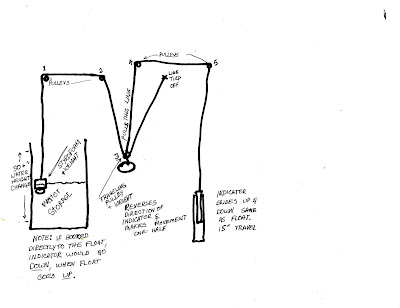
For those interested in "how things work," this rough sketch
shows the layout of components in the water- level- gauge.
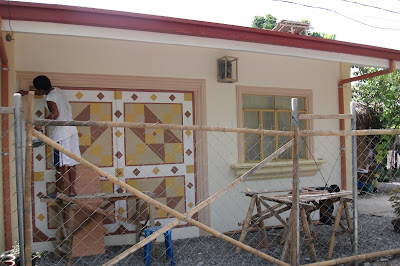
One day we re-mixed a number of small paint leftovers to get a
few pastel shades for the outside of the house.  Color-matched
paint is not available here yet, and most paint stores have limited
selection; "stock" colors often don't match the color chips.  So
we have learned to use darker stock-colors mixed with white, to
arrive at (or, close to) colors we want.  The saw-horse table out
in front took a long time to get rid of as it was the base for my
table-saw and I used it for as many debris-producing operations
as possible, to keep dust and other mess outside.
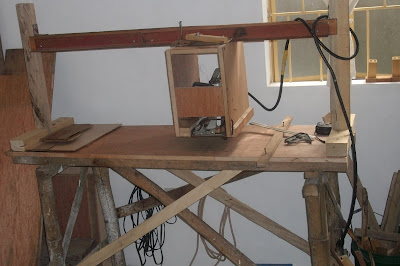
Several weeks of tinkering, and I had made an overhead-arm "arbor,"
with a box which allows the big Skil-saw to hang with its blade just-
touching a table below.  I adapted construction-scaffold into the table
which is portable enough - - -
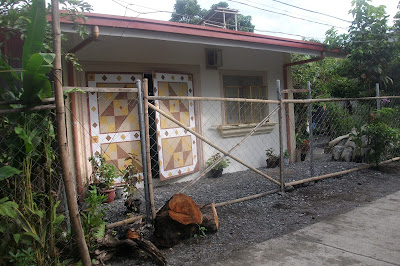
so I only have it outside when I'm actually using it.  The acacia-tree
stump which I'm using for chain saw testing will soon go away, too.
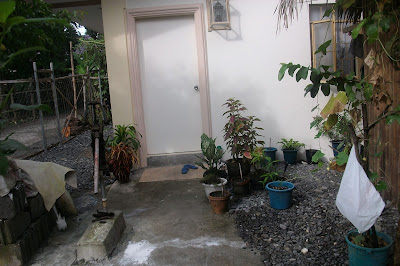
Here's how the "front door" area on the right side of the house is
looking now.  The concrete-block pile has nowhere to go until we
do the "outside kitchen project" in a few months.  The wall of
the bamboo house, featured in early blogs, is to the right.
Just inside the door, our small sitting room has shaped up nicely.
We will be building more bookshelves soon.  The fabric curtain
opposite the shelves covers a clear-plastic-strips curtain we made,
which helps isolate this part of the house from the workshop area,
and makes keeping out dust a lot easier.

Bernadette found this table, left side of previous photo, which
sets off the area very nicely.  It is locally made.
Meantime a small-scale project takes shape on the work-table.  Flat
pieces of 1/4- inch plywood are glued like the one standing up - it
has "tabs" sticking out on both sides from smaller pieces glued on
 its back side.  This creates slots or joints (like dadoes or rabbets,
which wood-workers cut with routers or table-saws).  In a couple
minutes, three pieces similar to the "tabbed" piece will have been
glued and fastened around the edges of the side-piece with the
shoe tacks, which are already in place. This creates the basic box,
which gets flipped over immediately for the other side to be put on.
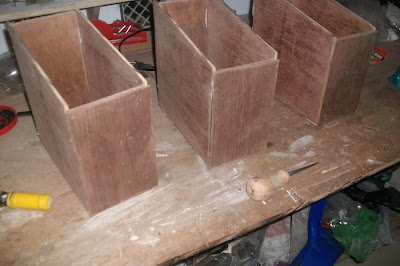
 This project was magazine boxes like libraries use to shelve collected
periodicals.  These can be bought at WalMart in the USA; I haven't
found any for sale, here.  (My awl, on the table, is made from a 5- inch
nail with a handle carved from scrap wood.  Couldn't find one, here).
Some paint improves their appearance.  The shoe-tacks used for
gluing were removed and their holes filled.We have quite a few "how-to"
 magazines, and these (total 7) will make it possible to organize them.

I've made several  "feed- trough" lights.  They use a small florescent
fixture like the ones used for counter-top lighting in kitchens.  An
inexpensive 10-watt tube will light a 4 x 6 foot area quite nicely.

Brief "side trip:" I didn't mention motorcycles in the previous "Vehicles" blog, but they are everywhere here.  I have ONLY seen one-cylinder bikes here; the largest I have seen is 155cc.  I suspect that there is an import tariff or some other law involved in this artificial-seeming limit, but I haven't found anyone to ask about it yet. 

I hadn't gotten any photo of "five-on-a-bike" previously, but it's
not unusual here. Usually they're moving and I can't get the
camera up in time.  This time I was walking, and they only
moved a few seconds later.

The project that "sneaked up:"  A rice-harvest cycle began last week, and Bernadette has had several requests for "collateral loans" on rice-fields.  It is common immediately after harvest for owners with "other fish to fry" to take loans on the fields, and use the cash elsewhere. The best of these we managed to "cover" and this gives us the use of that field until the loan is paid, and we have "first option" if the field is sold. The man who has managed this field (and others around it) has continued his agreement with us, and so we are suddenly farming on quite a larger scale than before.
It's up to us to provide seed, fertilizer, and sprays, and the harvest will be divided in shares.  This is 3- crop per-year rice land.

 Just a few days after harvest, the field is flooded and a contract-crew
begins  turning-under the stubble.  This part is about 1/4 of our field-
length, and we have three terraces, the other two a bit wider.
First section done, the machines are jumped over the terrace-dam - -
and they take off on the next section.  These terraces are 12" - 14" high.
 He leans really HARD to keep from tearing out the dam to his right.
Close up of the paddle- plus- triangular- claws which turns the
stubble under.  It looked like they were doing two "passes" over
each section of field.
 Break time and lunch meals were prepared at the house and taken
1/4 mile to the workers in a WalMart bag and a Lowe's bag.
Cold water and juice in 1.5 liter soda pop bottles, coffee water in
a Thermos . . .
Fish with vegetable stew in a plastic ice cream container, rice in
a former lard bucket.  A few things are NOT so different, here;
In KY our containers would have been margarine and probably
a 5- quart ice cream bucket.

We're real interested to see how the rice land will work out for us.
Ideally, it will become a local income stream that will  help us to accomplish some other projects.  Only time will tell if we've made a good choice.  
I keep meaning to do a posting about boats and fishing.  Fishing is a major occupation here, and many workers go back and forth between farming and fishing.  I can't say for sure what will be my next topic - we're getting closer to rice-harvest on our OWN farm now, so that's another possibility.
We will keep you posted!

Have a great weekend!

Tim and Bernadette Larson,  Philippines

Tuesday, August 27, 2013

Various Vehicles; (the "rundown" on them)

Commercial vehicles just aren't photogenic.  They pretty much all look the same, unless you have some particular interest in them.  It has seemed a little odd to me, that I haven't put much up here about commercial vehicles, since that aspect of the economy was literally "my life" for so many years.  Maybe it is "photographic challenge" (a little worried that it won't be interesting) which has caused me to procrastinate showing you some of the oddities of commercial transportation in our area of the Philippines.   You've already heard it before, from me - - Things are different, here.
First, the "culture" of driving is different.  There aren't as many regulations, nor speed limits per se, so in general the "professional" drivers (and many of the "civilian drivers") just plain drive faster in given circumstances than we're used to seeing in the USA.  Mostly, in "residential" or "congested" areas,  if there is no obvious obstacle - you get used to seeing vehicles roar through such an area at 50-plus mph, instead of the 25 - 30- mph you'd see in the USA.  The key difference here, is people are used to this.  They are more alert to approaching traffic.  Any driver or pedestrian entering the roadway just "naturally" allows that any approaching vehicle is moving fast.  And, any driver approaching a situation where he can see that someone may move unexpectedly, begins to honk his horn - - not a "mean, nasty blaring" honk, but just a tap- tap-  to alert everyone, just  in case.  There's really no reason to slow down, because nobody expects him to. It works out just fine.
We use buses and vans pretty interchangeably, when we're travelling here.  Any time after about 5:30 a.m., we can step out to the highway and expect to find buses and service vans coming along every few minutes.  Whichever one comes first, is usually what we ride.

This nearly-new service van was at the end of our street one afternoon,
so I snapped a photo.  Nearly all service vans are white - it makes it
easier for prospective passengers to see them coming and "flag" them
by waving. A placard in the windshield will indicate the destination.  Most
of them around here are the same model  Nissan "URVAN" with 5 rows
of seating in a medium-sized van body.  1.8 liter diesel, 5-speed, air-
conditioned.  Nearly always more banged-up looking, and often with
well over 100,000 miles on them.  Fare is the same as for a bus, usually.
 
You would NOT see this collection in a commercial passenger vehicle
in the USA!!  I made a list of the "critters" in my pocket notebook:  9
assorted plush toys, 2 bobble-head doggies, 6 dangling plush toys,
Virgin Mary, Buddha,  2 "Asian Deity" gods,  2 rosaries (all "religious
bases" covered), shoe, 3 air fresheners, 2 "waving rose" solar toys, 2
tassels, and a border of plastic flowers and leaves.  This van is apparently
privately owned and contracted to the transportation  company.

Technical stuff about vans:  Occasionally you'll see a Toyota, Kia or other make than Nissan.  One China-made van I rode in was a rarity - and apparently a never-to-be repeated purchase (clunker!).  Nearly always 1.8 liter diesel/ 5-speed; top speed about 100 kph = 62 mph. "Sardine act" inside at times with 18 passengers.  Less likely than a bus to have many-many stops because fewer passengers = fewer destinations.  Air conditioned, but often not real cool and hardly better than open windows many days.  Different companies have different standards, for maintenance and driver quality.

Ceres is the largest passenger-transport company in the Philippines.
Their yellow coaches are iconic, here.  They keep a high standard of
maintenance and are always respectably clean and decent (for a
commercial vehicle) though seats may be pretty worn and patched.
Fare for 45-mile ride to San Jose is US $2.00; they generally run
20 to 30 minutes apart, both directions, depending on day-of-week.
 "Buck Rogers spaceship accessory" styling of the ceiling light amused
me;  the buses are generally crisp-modern looking.  The lights around
the rim are LED-bulbs, and in the center is a mini-florescent tube.
Drivers are uniform-shirted and usually wear closed shoes (maybe
COMPANY policy?).  So this driver's flip-flops were unusual for CERES.

Technical stuff about their buses:   Their current crop of buses is Hino-manufactured (easy to find on-line, a BIG Japanese   company).  They are about 26-feet, 40-passenger,  4.5 liter diesel w/ 5-speed; equipped with engine "Jake" brake; very good low-end torque for lugging;  drivers tend to upshift pretty low-RPM (under 1700 often) though they are governed to about 2650.  Top speed also 100 kph.  Drivers will jump on the brakes and slow to 20 mph or less, then try to "lug out" in 4th or 5th gear .  THIS COMPANY has drivers who appear to have had some  professional training.  The passenger next to me smiled one morning when I tape-measured the seat-back in front of me - 13-inches wide.  I have ridden in one bus which picked up a crew of National Guardsmen - we were FULL-plus-FIFTEEN-standees in a 9-row bus.  I have ridden as a standee for 15 or 20 minutes at a time;  I call it "road surfing" because the motion of the bus and my inability to see ahead on the road (too many bodies in front of me) make for a lot of "footwork" trying to keep balanced.
The Agares have 2 vehicles.  CERES started out with one, in 1968.  This
bus (see "Cement Delivery" posting) is old but very carefully maintained,
as is their jeepney (more recent vehicle).  Several other bus companies
run through our area, often with "contractor" buses, and widely varying
standards for maintenance and driver proficiency.  These smaller companies
usually have cheaper fares than the "majors."
High-end luxury buses are also common here.  These are sometimes
tourist-transporters;  Boracay, a major resort island, is nearby and
these make the link to airports. Some buses, which have both recliner-
seats and "sleeper rooms" are for the Manila-transportation business.
The bus will board an ocean-ferry bound for Manila, and its passengers
will have accommodations instead of trying to live-on-a-bench for a day,
as less affluent ferry passengers do.  This service costs less than 1/3
of what airplane  travel to Manila costs. 
 Trucks look the same, everywhere.  I have only seen semi-trailer trucks
here on TV in Metro Manila traffic newscasts.  This is typical for a
heavy freighter here.  Tarp or "hard-shell" open sides are most
common -  better access to everything on-board.  Docks and fork-lifts
are not expected-as-usual;  "digital handling" (Digits = fingers, plus hands,
arms) is the norm.
I've seen only a couple of these old Isuzu conventional-cab (got a "nose")
dump trucks around here.  Everything else is cab-over-engine type.
Medium-size box trucks are also quite common.  This one is pretty
clean-looking; often they seem to be older than the guys driving them.
Fancy mechanical system folds and opens the aluminum sides of
this freight truck.  I've only seen a couple like this.
Really long tail-sections (behind the rear axle) are pretty common
here; when the truck turns, the tail swings the opposite direction
and can "clobber" things in its way, if the driver isn't careful. This
one seems like it could take out half a city block

Weird looking setup I've seen several times:  TWO steering axles and
ONE load-axle.  This would allow more weight to be towards the
front of the truck - but "why?" I don't know.
One reader asked me how the load stays in the Coca-Cola truck
(featured in "Road Trip" blog).  There are no roll-up doors on the
load-bays.  As in the USA, the floor is tilted so stacks are leaning
towards the middle of the truck; and, there are metal bars and
chains which fasten between the posts  

Technical stuff about trucks is hard to get - there's the language barrier, and drivers are pretty busy guys. Nearly all trucks here are Japanese: Isuzu, Nissan, and Mitsubishi mainly. Every vehicle I've seen here seems to be manual transmission, mostly 5-speed, except a few very "high-end" luxury pickups and SUVs.  Most of the trucks seem to be conservatively-powered (fuel economy, no 12 or 14-liter "hot rods") with everything super-durable long-wearing.  The sheer physics of keeping a heavy truck on the type of roads here, means that they are driven noticeably slower than buses and vans, in general.  These guys are usually very commendably cautious - they like being alive, I guess!

"Overloads:"  In the BLOG postings "Jeepney" and "Tricycle," I mentioned that quite often these vehicles are piled high with people and freight - but I hadn't caught any examples with the camera at that time.  (It's a constant challenge for me to have the camera ready as it takes 2 seconds to "turn on" and 1 second to re-set between shots - plus a lot of what I see is from inside a moving bus or van.)
Over many months, I've gotten a few good "shots" of heavily - or just bulkily - loaded vehicles:

I often see ten standees on the back bumper of a jeepney.  This
shot is a little tame - there's room for at least 4 more on the
lower part of that rear bumper- rack.

A mixture of freight and roof-riders? - no problema!

Refrigerator

Would you have believed me, if I had told,  but not shown?  The
pig was leashed on both sides, so he could move around, with
limits.  Loading must have been interesting - - agitated livestock
often make messes.
Group charter.

Tricycles get their share of large loads, too.  Here are high school
students on their way home.  Next photo in the camera showed
at least three of these tricycles loaded just like this, in a "convoy,"
but the photo was too blurry to publish.  The blur in this photo is
a combination of shooting through a tinted-film van window, and
being in-motion about to pass on the left.

Marching group members heading towards the parade staging area.
A load of bamboo passing through Bugyasong one afternoon.  We
had passed him a few minutes earlier, so when we stopped to let out 
passengers, I was waiting with the camera to catch him.
When we passed this guy en route to Culasi one day, I also took
the opportunity to wait on the road for him to catch up; here
he is,  coming - -
and going.  His cargo is rice-drying mats woven of lath-like
material;  they are about 6- feet by 12- feet, and often are
spread in the road with rice drying on them.  Rice growing
and processing is soon-to-be-posted here.

There are always more "things to see" in any photo- topic that I post, but this seems to me like a fair selection.  I'm glad that I managed to catch the various examples shown above, as it is pretty much a daily occurrence to see such things here.  In the next few posts I  plan to update some about our projects here, and to begin looking at some of the occupations seen in our area, which aren't so familiar in the USA.

Meantime, don't forget to count your blessings, and have a great day!

Tim and Bernadette Larson,  Philippines


Tuesday, August 13, 2013

A Bunch of Stuff

Actual published date, Wednesday, Aug. 14, 2013,  11:40 a.m. Philippines time

I usually try for a "straight topical" subject in each of my blog posts, but quite a few photos have accumulated which are either "singles" or "just a few," which are of things I see here that strike me as ODD - you wouldn't expect to see this (whatever) in the US of A.  So, this time I'm just going to start putting up "odd photos" and see where the posting ends up.
Things for sale:
This box of all-purpose white flour contains about 2/3 of a cup-measure.
I can barely think of how to use that small an amount; one-time breading
meat to fry (?) or whatever.  Poor people here often can only buy what
they need for immediate use, and very small sizes of everything are either
sold or re-vended everywhere.   But flour isn't poor-people food, here - -
and neither is meat,  or frying oil .
Very large sizes of things are also for sale, mostly for the purpose
of re-vending.  Here, approx. 10- gallons of vinegar or soy sauce
is costing (USA) $9  to $11.  These will very likely be re-vended
in small "sachets" - plastic bags - of 8- to 12- ounces, and the
mark- up could be several times what the vendor paid.
Here are re-vended vegetable oil in sachets, home-made coconut
vinegar in rum and brandy bottles, and nearby was flour, sugar, lard,
and many other "staple" items repacked and marked up.  One reason
why "the poor stay poor . . ." 
 
Small blister- packs of shampoo, baby-oil, dyes and conditioners, 
and things too numerous to count, hang everywhere.  "Travel-size"
or "hotel-sample" size seem to be the normal sizes here.  Eggs
sell "per each" here. about 13- 15 cents (U.S. money) - -
- - and often, so do cigarettes.  Here, you'd have to buy 4, in order to
spend exactly seven- pesos (20-cents US). They are also available by the
pack.  I don't buy, but the idea of buying one-at-a-time is odd- seeming.
Laundry detergent is most often sold in bar-form;  most people wash
by hand.   The white powder in upper-left is either  flour or sugar.
Soda pop - usually poured into a plastic bag (sachet - pronounced "saa-shay")
"to go" since the bottle deposit would cost more than the contents.
Many U.S. brands are manufactured in the Philippines, too.  These
Pringles were on a "two- fer" bargain special.  But notice the flavor.
I was used to seeing home-made fluids sold like this; when I asked
if the pink fluid was another type of vinegar, "they" laughed and told
me "it's gasoline."  The price, bought like this, is about a one- dollar
per gallon markup above the "gas station" price.  Current price here
at stations is above 6- dollars (converting pesos, liters, etc.).
This motorcycle- load of chickens was outside the market one morning;
they were blinking and turning their heads - alive.  I counted 6 on the
left side.  Don't know if they were headed into or out of the market.
Smaller birds nearby, had stalks of rice to snack on pushed through
their cage-wire.  These will be pets, I think.

The (sometimes) shocking truth: 
Racks of electric meters are a common sight on main roads.  Separate
wires run from each meter to its customer, sometimes quite far away.
Ours is here - its height of 10 ft. means we can't read it without a ladder.
Often meters are simply attached to the utility pole.  Note the "free-
form" routing of wires, very typical here.  (By the way, our electricity
costs USA 30-cents per KWH here; it was about 9-cents in KY)
Fish:
Piles of dried fish, many varieties, are always available at the market.
 You can get yours from a crate, if you didn't want to buy it off a
plastic tarp.  It is a national  favorite food of Filipinos;  an "acquired
taste" for westerners, as both its flavor and its smell are very strong.
 You're likely to see fresh fish just about anywhere.  Here, I was riding
the rear seat of a tricycle - as usual - and the rider behind the driver
was casually holding this large fish as we rode along.
Bro.-in-law Malon is often successful in his early-morning fishing.  This
was an above-average catch, though as the reddish fish is a particular
delicacy.  My flip-flop is for size- reference; the big fish is over 26- inches.
 Another morning he caught this spade-fish; again note the "shoe'" which
shows the fish as 5-1/2 "feet" long.  This is also a very mild flavored
fish which isn't too bony.  I can't find the photo of his 2-spade-fish
catch, which was about 2 weeks ago.  We eat lots of fish.

The photo turned out to still be in the camera.  A little hard to see, but
Gina is holding 2 spade-fish here.  Nice catch!  Note: background, there
is home-made coconut vinegar in-progress. Often they put a dozen or
more "tabasco" peppers in it  - a flavor "eye-opener!!"
Cooking:

The terra-cotta pottery stove replaced an older metal stove 2 days ago.
The old stove, like the cement stove on the left, had a fire-box sized for
charcoal, and the ladies are using more firewood lately.  This new stove
can easily fit pieces of firewood, not even cut to length but
pushed forward into the fire as they burn.

We have a 4-burner "apartment size" (Playskool size) stove with an oven.
The ladies still heavily use the "outdoor kitchen" because it is cooler (barely)
and the fuel is cheaper.  The B-B-Q size fuel bottle shown costs US $21-
dollars to fill; we use about one per month even being careful; that's nearly
a week's wages for a Filipino worker in this area., so most can't afford it.
The outdoor kitchen will be re-modeled/ expanded some next year, we hope.

Finally,  I only sent the next photo to a handful of people, by e-mail.
I saw our puppy, "Smarty," playing with one or our cleaning tooth-
brushes one day, and just waited a minute or so to get the photo
I wanted.   The "Hygienic Hound."  He got sick a few weeks later;
there are no veterinarians here and he didn't recover with the medicine
we were able to get at the feed store.  Glad we have a couple cute
photos to remember him by.

There are still quite many "miscellaneous" photos in my collection, so from time to time I may do this again; especially as I only hit 4 or 5 subjects this time, and not too heavily on any of them. I will get back to some of our "project progress" as things move along here, and I have quite a few "Philippine Occupations" photos, and a handful of other topics mentally sketched out.

Meantime we hope that you all are doing well.  Life isn't so much what happens to you, as it is what you make of what happens to you.

Have a great day!

Tim and Bernadette Larson,   Philippines