Tuesday, August 13, 2013

A Bunch of Stuff

Actual published date, Wednesday, Aug. 14, 2013,  11:40 a.m. Philippines time

I usually try for a "straight topical" subject in each of my blog posts, but quite a few photos have accumulated which are either "singles" or "just a few," which are of things I see here that strike me as ODD - you wouldn't expect to see this (whatever) in the US of A.  So, this time I'm just going to start putting up "odd photos" and see where the posting ends up.
Things for sale:
This box of all-purpose white flour contains about 2/3 of a cup-measure.
I can barely think of how to use that small an amount; one-time breading
meat to fry (?) or whatever.  Poor people here often can only buy what
they need for immediate use, and very small sizes of everything are either
sold or re-vended everywhere.   But flour isn't poor-people food, here - -
and neither is meat,  or frying oil .
Very large sizes of things are also for sale, mostly for the purpose
of re-vending.  Here, approx. 10- gallons of vinegar or soy sauce
is costing (USA) $9  to $11.  These will very likely be re-vended
in small "sachets" - plastic bags - of 8- to 12- ounces, and the
mark- up could be several times what the vendor paid.
Here are re-vended vegetable oil in sachets, home-made coconut
vinegar in rum and brandy bottles, and nearby was flour, sugar, lard,
and many other "staple" items repacked and marked up.  One reason
why "the poor stay poor . . ." 
 
Small blister- packs of shampoo, baby-oil, dyes and conditioners, 
and things too numerous to count, hang everywhere.  "Travel-size"
or "hotel-sample" size seem to be the normal sizes here.  Eggs
sell "per each" here. about 13- 15 cents (U.S. money) - -
- - and often, so do cigarettes.  Here, you'd have to buy 4, in order to
spend exactly seven- pesos (20-cents US). They are also available by the
pack.  I don't buy, but the idea of buying one-at-a-time is odd- seeming.
Laundry detergent is most often sold in bar-form;  most people wash
by hand.   The white powder in upper-left is either  flour or sugar.
Soda pop - usually poured into a plastic bag (sachet - pronounced "saa-shay")
"to go" since the bottle deposit would cost more than the contents.
Many U.S. brands are manufactured in the Philippines, too.  These
Pringles were on a "two- fer" bargain special.  But notice the flavor.
I was used to seeing home-made fluids sold like this; when I asked
if the pink fluid was another type of vinegar, "they" laughed and told
me "it's gasoline."  The price, bought like this, is about a one- dollar
per gallon markup above the "gas station" price.  Current price here
at stations is above 6- dollars (converting pesos, liters, etc.).
This motorcycle- load of chickens was outside the market one morning;
they were blinking and turning their heads - alive.  I counted 6 on the
left side.  Don't know if they were headed into or out of the market.
Smaller birds nearby, had stalks of rice to snack on pushed through
their cage-wire.  These will be pets, I think.

The (sometimes) shocking truth: 
Racks of electric meters are a common sight on main roads.  Separate
wires run from each meter to its customer, sometimes quite far away.
Ours is here - its height of 10 ft. means we can't read it without a ladder.
Often meters are simply attached to the utility pole.  Note the "free-
form" routing of wires, very typical here.  (By the way, our electricity
costs USA 30-cents per KWH here; it was about 9-cents in KY)
Fish:
Piles of dried fish, many varieties, are always available at the market.
 You can get yours from a crate, if you didn't want to buy it off a
plastic tarp.  It is a national  favorite food of Filipinos;  an "acquired
taste" for westerners, as both its flavor and its smell are very strong.
 You're likely to see fresh fish just about anywhere.  Here, I was riding
the rear seat of a tricycle - as usual - and the rider behind the driver
was casually holding this large fish as we rode along.
Bro.-in-law Malon is often successful in his early-morning fishing.  This
was an above-average catch, though as the reddish fish is a particular
delicacy.  My flip-flop is for size- reference; the big fish is over 26- inches.
 Another morning he caught this spade-fish; again note the "shoe'" which
shows the fish as 5-1/2 "feet" long.  This is also a very mild flavored
fish which isn't too bony.  I can't find the photo of his 2-spade-fish
catch, which was about 2 weeks ago.  We eat lots of fish.
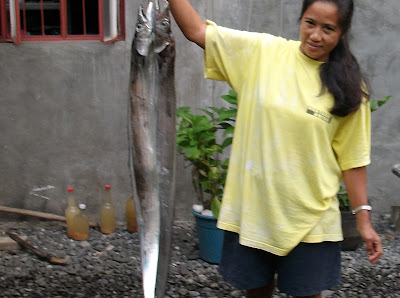
The photo turned out to still be in the camera.  A little hard to see, but
Gina is holding 2 spade-fish here.  Nice catch!  Note: background, there
is home-made coconut vinegar in-progress. Often they put a dozen or
more "tabasco" peppers in it  - a flavor "eye-opener!!"
Cooking:

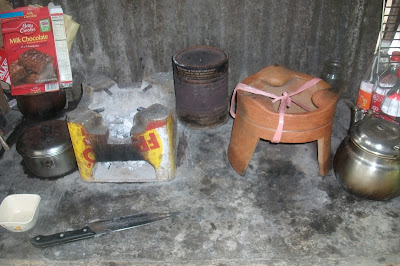
The terra-cotta pottery stove replaced an older metal stove 2 days ago.
The old stove, like the cement stove on the left, had a fire-box sized for
charcoal, and the ladies are using more firewood lately.  This new stove
can easily fit pieces of firewood, not even cut to length but
pushed forward into the fire as they burn.
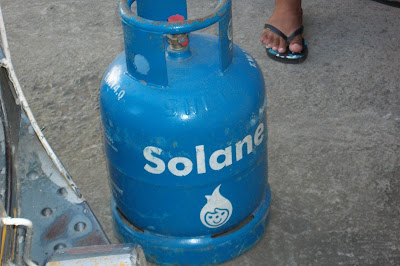
We have a 4-burner "apartment size" (Playskool size) stove with an oven.
The ladies still heavily use the "outdoor kitchen" because it is cooler (barely)
and the fuel is cheaper.  The B-B-Q size fuel bottle shown costs US $21-
dollars to fill; we use about one per month even being careful; that's nearly
a week's wages for a Filipino worker in this area., so most can't afford it.
The outdoor kitchen will be re-modeled/ expanded some next year, we hope.

Finally,  I only sent the next photo to a handful of people, by e-mail.
I saw our puppy, "Smarty," playing with one or our cleaning tooth-
brushes one day, and just waited a minute or so to get the photo
I wanted.   The "Hygienic Hound."  He got sick a few weeks later;
there are no veterinarians here and he didn't recover with the medicine
we were able to get at the feed store.  Glad we have a couple cute
photos to remember him by.

There are still quite many "miscellaneous" photos in my collection, so from time to time I may do this again; especially as I only hit 4 or 5 subjects this time, and not too heavily on any of them. I will get back to some of our "project progress" as things move along here, and I have quite a few "Philippine Occupations" photos, and a handful of other topics mentally sketched out.

Meantime we hope that you all are doing well.  Life isn't so much what happens to you, as it is what you make of what happens to you.

Have a great day!

Tim and Bernadette Larson,   Philippines


Sunday, July 28, 2013

Filipino Pharm

Our farmland has been undergoing soil preparation and planting of a rice crop for about a month now.  We live "in town;"  barely 100 meters west of us is the seashore; beginning 100 meters east of us is a wide rice-land several hundred meters wide, extending a couple kilometers between the "settled" area we live in and a range of hills.  We follow a secondary road through these rice fields, and wind our way into the hilly area for perhaps 1.5 km. to reach our farm.  I can walk there in between 15 and 20 minutes.  Our plans are to rehabilitate land which has not been farmed for a generation or so, other than some occasional small "convenience" plantings around the fringes; bananas, pineapples and perhaps a few other things through the years. We will grow rice in the areas which have prepared terraces, and try to grow garden-vegetable crops in mostly-sloping spaces around the rice-fields, and on the "other side" of a stream which passes through the property.  Here are some photos to show you  a little of what the area looks like, and the process of getting the farm into production up to now.
It was a pretty morning recently, and as we walked through the rice-land
area I decided to try to catch the mist on the hills with my camera.   Fields
in the center are being replanted with the second crop.  The road continuing
is visible just left of center; it begins to climb just after that point.
A short distance of  upgrade, and to my right is this view of terraces 
downhill for about 200 meters. (meter = 1.10 yard)
On the left is this impressive residence; its owner was  M.D. practicing
in the United States for many years.  His place could be just the other
side of Clampett's from Drysdale, the banker's house, in Beverly Hills.
This is his fence-line for about 75 meters, along the road.  Some of the
rice-fields adjacent to this 3-or-so acre compound are his, and he has
tenant farmers working them (as we do, with our smaller property). The
cement part of the road has ended just before this, and it is another
3/4 km to our place from here.

 Arriving at our property, we find the plow-man already hard at work.
The early part of the rainy season has allowed the terraces to be
flooded, so that the soil is somewhat softer  than if it was dry. His
ergonomically correct, sustainably biomass-fueled "tractor" enables
him to plow and to fertilize (random-cycle only) in one operation.

  Junior "trainee-tractor" follows mama for much of the day, and receives
on- the- job- training in the business.  The plow is very similar to ones
in the U.S., designed to "cut" and roll-over the soil.
 This shows the 2 "upper" terraces  plowed while I was on-site that day.
They  seem to be about 20-meters on their widest ends, tapering to about
8-meters on their narrow ends, and 50-meters long. I'm looking slightly up-hill
at them from a point where the terraces all "change direction" cross-way, because
of the way the land slopes. The "lower ones" were also plowed later that day.  
Looking downhill from about the same place, gives sight of 5 "lower"
terraces which roll downhill towards a seasonal stream behind the  small
bamboo house which can be seen upper-center.  We have other fields
beyond that stream. The area viewed here is approx.100- x 75- meters.
All of this terraced  land  will be planted  in rice   (for now,"Monsanto-
Cargill-ConAgra" types but LATER, we shall see) to provide a basis  for
living to us and to our "tenant farmers" who depend on the harvest for
their livelihood.  This is the land in "BEFORE" condition.

This is the same terrace in the above photo, 4 days later.  The land has
been plowed and flooded, but the dirt-clods are still too large.  A walk-
behind tractor (common here) with a harrow is used to break them up.
I thought, "He will NEVER get up out of that bog - the way that machine
is sunk in, it looks like a mud-wrestling pit -"
but here he is a couple minutes later; he easily harrowed to the end
of the terrace, and this is his return-trip coming towards me.

Close-up shows the metal "paddle wheels" used for this type of job.
These can be replaced with "tractor tires" for other less muddy tasks.

Walking 30 meters to the right, from the bamboo house 3 photos
above, takes you down a rough-sloping path to this part of the road.
One of our early tasks (a different day from the plow/ harrow days) was
to run the water-service line from the "main," on the opposite side of
the road,  under the road to our side.

The "saddle-tap" had been installed with the pipe angled downwards; we
had quite a hassle hooking up because our line is parallel to the ground.
We finally managed to bend our pipe enough to thread the two together
with a "pipe union" fitting, which uses a collar to secure the pipe threads.

Nearly 3 weeks after the "harrowing experience," this view is nearly-same
as the BEFORE view several photos above.  The terraces have been plowed
again after harrowing, and kept flooded.  meanwhile, a 20 x 20 meter area
was direct-seeded with rice, which is now about 16-day seedlings.

To the left the above view, workers are gathering the rice seedlings
and tying them in handy bundles for re-planting.

Here, the seedlings are quickly set into place in several inches of mud.
The replanted rice is set on about a 6- or 8-inch spacing.  The reason?
My guess is that this is the most productive spacing for the plants, but
near-impossible to achieve by "scatter-seeding."  Automatic seed-drill
machinery would be impractical - cost far too much, for one thing.

 Here are the 2 "upper" terraces, on planting day, the same ones shown
from their other (20 m. wide) end on "plow day."  These, and the 5
"lower" terraces shown  4 photos above, were completely re-planted
by the workers before 4 p.m. on planting day.
"Mama tractor" looks pretty content on planting day.  And why not?
(thinking) "If they're PLANTING, I'm not PLOWING . . !"

This is just one side of our farm.  The fields beyond the stream (see "BEFORE" caption above)  are just now being plowed, a couple weeks after "rice planting day."  They will have more "garden-type" vegetables growing in them.  We're learning as we go along, what will grow here, and how to grow it.  Local types of produce will need to be a "mainstay" for a while, but we hope to grow some additional varieties more familiar to us later on.  I'll add a couple photos of the "other" side, so you can see what it looks like.

I'm in the stream-bed behind the bamboo house; my right side is towards
it.  The road bridge over the stream is about 4 m. (13 ft.) high, and the
field-level at that house is another 4 or 5 m. above road level.  It's less
"scrambling" to walk out to the road, than it is to go down, then up, the
paths on the stream banks - going from "one farm" to the other.  This
is the stream-bed where our "lumber" was cut,  (see 5th BLOG)
This looks towards the road, from one of the "other side" fields.  The 
clump of trees upper-center hides the road-bridge 20 m. beyond it. 
This level and fairly open space could grow a lot of vegetables.  Behind
me, a steep hill goes up abruptly, covered with trees and brush.  At
the sheltered base of the hill is a permanently-shady place which I
think would be good to build a partially-underground "cool room" 
for "dairy" and other food-processing work.
Turning right from previous photo, and scampering about 10 m. between
some large rocks (and one "mini-hill," house sized) brings you to another
field, about the same size (acre?- plus) as the previous.  Again, a good
location for garden-crops.  On this side of the "farm" we will also try out
dairy-goats.  Dairy products are not a mainstream part of the culture here,
and imported milk, cheese, etc. is expensive; so we will try to find the means
needed (goat, and cow) to make our own milk, cheese, ice cream, buttermilk,
sour cream, cream cheese, yogurt (which will substitute for several of the
others) - quite a few items you would just run to the grocery to get.

Last-minute addition!  I haven't tried scanning and transferring to this program before - - here's a
sketch-layout of the farm, not to scale and I'm not much of a draftsman.  But it may help you to
picture in your mind what I've been trying to describe in the photos and captions.

That's about what it looks like for now.  The garden-crops which we CAN grow at this time of the year will soon be in place.  For some crops, the rainy-windy season we are entering is destructive (corn, for example).  Some crops will be planted more-like November, when there isn't as much rain and Typhoon Season is past.  We will learn as we go along, and rely quite a bit on our care-taker tenants; I think that they have the knowledge of this area and should pretty much do what they want to, since they have a "stake" in whatever comes from harvest.  I would like to grow things organically (there's a HUGE amount of soil amendments of all sorts available, much of it unused it seems to me). I'd like to have more than the 2 types of tomatoes common here, and more varieties of onions, some zucchini and other squashes, some berries and other fruits - - but I don't know what the growing conditions here will allow.  As I find out in the next couple years, I'll keep you posted.

Meanwhile, we hope that you are noticing the blessings and "minor miracles" which punctuate EACH of our days.  "Every good and perfect gift comes down from Above, from the Father of Light . . ." and His influence molds each and every event to our benefit - - if we only stop to really see.  (Another way of putting it, "It's ALL good;  only our perception makes it seem "good" or "bad.")

Have a blessed and peaceful day - -

Tim and Bernadette Larson,  Philippines

Friday, July 19, 2013

Showing off my Drawers

I thought our house was finished a few weeks ago.  It seemed like everything was nearly in place and would be all organized pretty quickly. But, sometimes it seems  like I get over-optimistic about progress towards a particular goal, not to mention about things- in- general.
       (As a general rule, I would describe myself as a "cheerful pessimist," which means I expect things to go wrong  [that's not as planned according to my perception of how they should be] but I also expect to somehow work around the problems or to adjust to them.)
       Optimism as a point of view is just a little too rosy for me usually, so I'm a little surprised at having caught myself at it - - and also maybe a little gratified to find out I was wrong.  All kinds of things still needed to happen before we would be settled down and moved in - - and  lot of them are still evolving. 
        At the least, the continuing stream of little tiny projects (see earlier references to Fisher-Price and I think maybe also to Playskool)  keeps me from becoming a couch-potato.  And I've learned of a few more things to count as blessings, no longer taken- for- granted!
Limited space in our new bathroom demands that what space there is, 
be used effectively.  We needed to have some built-in storage under the
sink;  the area is less than 24- inches wide and 16- inches deep.
I decided to put a set of small drawers under the sink, and some
shelves with doors below them.   First I needed to cut "frame-sticks"
about 5/8 x 5/8 inch, from larger scraps left from construction (I think,
from one of the 3- by- 5 rafter-ends).  These I jointed and glued into the
two horizontal frames shown.  Then, I glued and clamped side- and
center- panels made from 1/4- inch plywood into place, creating a basic
"chest of drawers" box- frame.  Here, sticks for the drawer side-guides
are clamped and glued onto the plywood panels.

Meanwhile, I've been cutting drawer-pieces from 1/4- inch plywood
stock.  Here, drawer sides are getting  flat "sticks" glued on their outsides.
Another piece will be added, with a gap in between, to make the slot
which will slide on the side-guides in the frame.  Near pieces are for
lower 9-inch deep drawers.  Upper drawer sides (near glue jar) are
less than 5- inches, because they must allow for the basin.
Here, drawers are complete except front-panels.  The drawer on the
lower right shows the completed guide-slot.  Just how the drawers will
slide on the side- guides shows pretty well on the upper- right drawer.
I found that aligning and gluing the drawer-fronts was tricky - as I'd
expected.  I finally glued and clamped them with the drawers sitting
in their - hopefully - resting positions in the frame.  The project's
final appearance depends on these fronts being lined up evenly.
Painted and installed, the drawers look OK and all of them track nicely.
I'm probably the only person who will ever notice the minor flaws.
The drawer-unit took 5 days to make and install.
The two upper drawers, being very short, tended to slide all the way
out of the cabinet and dump their contents - causing me to voice some
vexation.  A clothes-pin  is now screwed to the back of each drawer
with its tail set high enough to catch the underside of the tile edge -
so the drawers now only come out by releasing the pin.

Cabinet doors painted and installed a couple days later give a finished
look to the area.
The next project needed 32 clamps to be in use at once.  Bernadette
kindly supplied me with a brand-new package of clothes-pins which
did the job just fine. Here is a 3- inch wide piece of 1/4 plywood, with
shorter pieces glued and spaces between them (white glue-stripes
visible). The spaces will be shelf-rests for - -
- a medicine cabinet, of course.  We couldn't find one of them ready-
made to buy, but by now I was getting fairly handy with working
on small-scale cabinets.
Painted and assembled, it looks OK.  The back panel is some left-
over from Kentucky, which I had cut for reinforcing material in our
shipping boxes.
The cabinet was sized to match a framed mirror we bought, and it
looks pretty "normal" as installed above the sink.  It only took
about two days to complete this.

Some glue-joints (esp. corners) can't be clamped; and I had a hard
time finding small nails here.  Finally I found a box of shoe-nails which
have worked out pretty good.  The peso-coin shown for size, is about
the size of a US quarter.
What good is a bathroom without a warm shower?    Not much.
Water heaters here are the on-demand (flow-through) electric type.
They're expensive and electricity is high, here, too.  We decided to
try putting this 3-inch pipe in a grid on our roof.  Within about 2 hours
of sun-rise, the water is quite warm, and HOT in the afternoon.  It
stays warm a couple hours after sunset.  We've had pretty good
success with our water-tower system, featured 2 issues back.

But so far, that's only the bathroom.  A lot of other things have been
worked on meanwhile.  Hard to believe this add-on shelf unit to the left
of the store-room door is less than 24 hours old.  The main clue?  Not
every single space on the shelves is full yet.  That might take 48 hours.
This unit is absorbing the "put and take" stuff which has been occupying
my bookshelf (see "Totally ON the Wall" several postings ago) since
early in May.  NOW, maybe I can unpack some books . . .
So far, we have been managing to unpack at a rate not TOO far ahead
of our available storage and immediate needs.  But we still have about
20  of these shipping boxes to unpack and absorb.  We'll see how it goes.

Also  meanwhile, the night-table/ computer-communications desk has
gradually been evolving in the corner next to my side of the bed.  This
space, while small, must accomplish a lot.  Right now it seems like the
next "additions" will be 2 bookshelves on the wall to the left (above the
printer) to hold books which are currently- in- use or are "frequent
references," and a small cork bulletin-board for temporary notes.
The bed- frame shown in "Fisher-Price" a couple postings before,
has been in use for several weeks.  So, "also in the meanwhile," I
have been building drawer-like "totes" similar in function to the
plastic ones which are often used for under-bed storage in the USA.
The plastic ones are also available here, but pricey, and they don't
fit "just exactly" the space we have.  THESE take the place of'
a dresser-drawer set, which we lack space for.
Finally, also "meanwhile," we have been getting the farm property into condition for crops.
The "Filipino Pharm" is likely to be the next  posting, showing what is necessary by steps to re- cultivate land out- of- use for perhaps 30 or more years.  ONE of our purposes here is to become self-sufficient as much as possible, producing most of our own food while "hobbying" in learning cheese-making, sausage-making, meat-smoking, sourdough-culturing (see, we DO want to have some "cultural activities" here!) and honey
bee-keeping.  Hard to tell when and IF all this will happen, but we will certainly have plenty to keep us active and challenged for quite some time.

We hope you are having a blessed and rewarding year- 2013.

Tim and Bernadette Larson,  Philippines