Sunday, July 7, 2013

The Opposite Direction

I walk along the beach nearly every afternoon, usually around sunset.  I also try to get out and do so in the mornings, before 7:00 if possible, but lately have been a little bit lax.  The two photos below are from one recent afternoon, and they show graphically one of the "simple pleasures" of being here.

 This is the view south-west from  Malabor, which is our Barangay
(the word for neighborhood) at Tibiao.  The object in the ocean is
a bamboo fishing raft which appears to be about 15- feet by 30- feet.
Often twenty or more people will be fishing from the raft, and sometimes
using canoes to deploy nets.
When I turned to face nearly west,  this was the sunset that afternoon.
Culasi is the next municipality from Tibiao as you head north along the coastline of Antique Province.  The main part of the town is about 20 km from us and we occasionally travel there for various supplies and building materials - some things aren't available at Tibiao, and it's a shorter trip to Culasi (koo-LOSS-ee) than it is to San Jose (the Opposite Direction).  But we mostly head towards Culasi on Sundays, as that is where our church congregation meets.  It's a little shorter trip than going all the way to "Culasi Proper," as the site is on the nearer outskirts of the Culasi area, about 11 km. from us  (7 miles).  Since I earlier showed some of the sights I see when heading south towards San Jose, I'll show here some of the scenery headed north.
We always travel to Culasi by tricycle - we have a regular  Sunday
appointment with our driver.  Since I have a hard time scrunching
into the front seat, I ride in the back seat;  I would be sitting side-
way if I were in the above, where the two people are riding.  I often
see 3 skinny-buns Filipinos riding in the back of a tricycle.  This is
the National Highway within 100 yards of our house.
Heading north from Tibiao the scenery is often just like this, expansive
fields, trees, and mountains always brooding in the background.   I call
this type of view a "post card" because it is so natural to this area.

The road to Tibiao Eco Adventure Park is shortly after the town.  The
sign mentions waterfalls, kayaking, and caves.  I'm told that the walk-in
distance to the attractions would be too much for me, but I intend to
find that out for myself some day soon.
About 2 miles beyond the turnoff for "Tibiao Proper," the Tibiao River
bridge comes into my category of "long bridge" as it seems to be more
than 200 yards in length.
One category of vehicle I haven't mentioned before is a "biomass-
fueled" tricycle (pedal powered).  These are nearly always side-car
style, like the motorcycle- tricycles.  They are called  trisiked (siked=
pedal) and are very common in towns, both as passenger and as freight
carriers.   Here are two making a several- mile jaunt between  areas.

All kinds of places appear along the road; there are many medium-
prosperous seeming houses which are upscale enough to have a few
"architectural details - - -"
 - - -and a seemingly equal number of bamboo mini-stores, which are
more "organic looking.*"  In the "middle of nowhere" they somehow
stay in business.  (*"Hello - Gilligan?")

 Schools in our area are always enclosed in some sort of concrete-
plus-metalwork fence, sometimes simple angle-iron with points on
top, and sometimes more elaborate "wrought-iron work" with scrolling
and leaves.   The names of fence-donors appear below each panel.
 There are many places with "Spanish-Moorish" stylistic influences.
Many times passing-by, I've been intrigued and wonder how a very
expensive earth-moving machine comes to be parked with several
years-worth of vines and brush growing over it.  Parts trouble?

 This very prosperous-looking house is surrounded by rice-fields and
has a large concrete rice-drying pad (solar energy!) on one side.

The next four photos may be the best sequence I've managed to shoot here. I just happened to have the camera ready, and there was enough time for it to re-set in between shots.
As usual I'm sitting facing backwards in the tiny tricycle side-car when
a large truck overtakes us.  Notice the California Pacific-Coast Highway
scenery in the background - - -
 He moves in pretty close - waiting for his opportunity to pass, delayed
briefly by opposing traffic.
 Now, he's starting to make his move.  He can do over 60 mph, and
we  "top out" at about 25 mph.
I could not quite have touched his drive tires by stretching out my
toes, but it surely seems I didn't miss by more than "a foot - - "

This structure is one- vehicle- width from the highway, and is solidly set
on concrete piers.  It seemed to go up in "no  time at all" - probably a few
weeks  - - -
- - -and was quickly in operation as an open-air restaurant, bar, and
grill with the fine view of the ocean (which is hard to capture), beyond it.
Our congregation meets in a simple open-sided structure which overlooks
the ocean, about 200 feet away.  It's a beautiful site, developed for seminars
and conferences, with the murmuring of the waves always in the background.


I've tried to capture the perspective, looking towards the ocean, but it's
hard to really show it.  The trail seems to drop 30 or 40 feet in elevation
on about a 50- yard walk down to the beach.

There was an ocean baptism on the day I was taking photos.  A very
beautiful location for a memorial event.

The rest of Culasi will have to wait for another blog-post sometime later.  Mostly it would be a couple photos of the lumber-yard (home-made machinery), the hardware-and-plumbing suppliers, the window-fabricators and maybe the "shade-tree" side-car factory.  Nothing really remarkable - - I hear there are some municipal and provincial official-buildings but I actually haven't been as far as the "town square" if there is one, except "passing thru" on my first trip to this area 11 years ago.  Everywhere we have gone since arriving here in November last year, has been errand- objective- oriented.  Eventually we will have our priorities "settled down" enough to take a more leisurely look at our surroundings;  likely within the next 6 months.

I have been "covered up" with an amazing variety of small projects lately - the "Fisher Price Effect" with a little "Playskool" thrown in.  I think it has taken me 2 weeks to put together this blog, having started - if I remember right -  2 Sundays ago.  Usually these take me an hour or so to put up a bunch of photos and caption them.  Some of what I've been up to will be in later postings, and I'm just "itching" to also get up an issue or two of miscellaneous "stuff I've also seen" which is odd or interesting but doesn't fit into my pre-conceived categories.

Meantime, we hope you all had a great Independence Day Celebration of the greatest nation mankind has ever been blessed to see.  (We got to do some 'merican things here like home-made ice cream, hot dogs, hamburgers, potato salad, and Devil's Food Chocolate Cake - - my celebration-mind always seems to move towards my middle!).

Have a great week, everyone!

Tim and Bernadette Larson, Philippines

Sunday, June 16, 2013

Fisher-Price & Price-Pfister

Fisher-Price is a toy company.  They make a lot of "small stuff" like toy kitchen appliances, mini-shopping carts,  and toddler-sized plastic vehicles. Young kids can imagine that they are "all grown up" with the help of Fisher-Price products.  This sort of smallness is one of the topics I hope to develop some, in this posting.
Price-Pfister is a faucet and plumbing supply company.  They supply bathroom and kitchen faucets in a huge variety of styles and price ranges from fairly basic to "Buckingham Palace Royal Lavatory."
Faucets and small stuff collided unexpectedly as concepts for me, during our recent house- construction (which continues, and continues, and continues as "small details" are still being completed).  It happens, too, that the "near-miss" to a palindrome (word or phrase that reads same forwards and backwards, like "Madam, I'm Adam.") caught my humorous imagination.  (Yeah, I KNOW the two companies' names aren't an actual palindrome, but something of the concept is there, at least phonetically.)

Here's what happened:  I JUST PLAIN GOOFED.  I did my design floor-plan of the house on 1/4- inch standard graph-paper, which has been my habit for years on projects complex enough to require a scaled- drawing approach.  Most times the plans instead come "out of my head" in-process or are merely sketched informally on scrap paper.  I didn't know, but soon learned, that in the Philippines, bathroom walls are ALWAYS constructed from concrete-blocks with a foundation under them.  I had carefully measured the bathroom in our existing house and determined that we could "get by" carefully with a 6- foot square bathroom, being what in the USA would be a 3/4 bath (shower, basin, commode), as tub-bathing just seems not necessary here.  When we left one morning on an all-day errand the crew was building perimeter block-walls.  When I returned the bathroom interior walls were half-built, with 6-feet  as their outer dimension, instead of the inner dimension.  Well I didn't have the heart to make them tear it all out and re-build; besides we hadn't actually bought the fixtures etc. yet so I "crossed my fingers" and spent a couple months  wondering if everything would fit.

Eventually we got it finished, and it did all fit, in a space 62- by 63- 
inches.  The shower stall  (to left of the "splash wall") has no curtain yet
in this photo,  Walls are half-tiled, top half paint.  It works OK for us
but anyone larger than me would find it a snug fit.  "Fisher Price," yeah!
Many things I used to take for granted, I now appreciate.  Shower
valve-sets (hot & cold, with riser for shower-head) were not available
anywhere.  I finally found two single valves (made by Price-Pfister, USA)
which I could "T" together behind the shower wall.  We enjoy the
convenience of a shower head which can be hand held or hung up.
Meantime out beside our "new" bamboo house (see much earlier issues)
a 7- feet deep vault was dug, with extra-heavy footings and posts poured
as cement-block walls were built upward.
The 8- x 12- inch concrete beams and thick posts, supporting 2nd and
3rd floors, could almost be for a parking garage, it seems. 
Top floor in place, reveals the purpose;  water reservoirs made of
re-purposed food-liquids drums.  Why bother with such a project? 
The local water utility usually has not enough pressure to feed a shower-
head!  Also the hours of service are often limited.  We draw water from
our well via an electric pump system,  to fill the drums.  A shower might
seem like a LITTLE thing, but NOW, you know why I REALLY
don't take it for granted!! (I never would have imagined going to such
lengths of effort, to get one)
The ground floor of our new structure houses "The Last Quarter Lounge
and Spa," which has a "quick stop" bathing and "comfort room."  Counting
from the vault to the tank-level, we are proud owners of a 4-story "facility."
(the word I'm not using here, is opposite of  IN-house)
 The view upward from the bottom of the ladder.
 Wonderful view, in all directions, from the top.
Watch where you step, as you prepare to descend.
A "little thing" now greatly appreciated: our Select Comfort mattress
which we could ship, and we are able to use again.  The bed-frame could
not reasonably be shipped, so this now-complete frame serves us here.
I didn't find closet doors ready-made here (we sure miss those
quick trips to Lowe's!) so I spent about a week puttering and
building four of them from sticks and 1/4- inch plywood.
"Impressionist painting" on the installed doors creates the
impression that they are framed-panel type, but they aren't.
Their front panels are as flat as I could make them (which
isn't, entirely, flat - - or, straight).  I used to take closets much
more for granted than I do now;  I really appreciate
this one being DONE!
At this point I'm still not exactly sure how to say what I've been trying to say.  Maybe it's just, "I don't take small blessings quite as much for granted now, as I used to."   A little while back, I was fussing to myself about a lot of little inconveniences, and I muttered, "Well, camping out has been fun, but someday soon I'm going back home!"  That's one thing about the Philippines: the way many people live here has much in common with Americans' idea of going camping.  Camping is fun, for a lot of people, but most people wouldn't describe it as "easy" or "convenient."  People do it because they want to experience different surroundings ("Nature") for a while.  The little challenges of adjusting to a different routine can be part of the "fun," depending on how a person looks at it. I'm glad to be in the Philippines.  A year ago, my challenges were different as I worked on a job that, while enjoyable most times, was getting to be too much for me. I could not have imagined that a few months later I would be here - our expectation was more likely a couple years from now. But it is over-all a good experience for me to have been here these 7 or so months, adapting to some of the circumstances, and gradually changing other things to suit myself.

May each of you experience the blessings and satisfaction of meeting small and large challenges in your life.

Tim and Bernadette Larson, Philippines

(She is not a writer - maybe I'm not either! - but she is probably the larger part of what happens around here)

Thursday, May 23, 2013

Road Trip

We definitely "know the way to San Jose," the capitol of Antique Provence; we travel the 70km  (about 44 mi.) to go there pretty frequently on various errands.  I haven't kept exact count but it's fairly certain that in 26 or so weeks we have been in the Philippines that we have made more than 15 trips, as we seem to average about every week-and-a-half.  There are services  and goods in San Jose that either aren't at Tibiao, where we live, or are enough cheaper to make it worth the trip: health care, grocers, supermarket, "discount emporium" type merchandisers,  large-scale building supply/ hardware/ equipment companies, and furniture and appliance stores. (Wikipedia has good articles about this area; type San Jose, Antique, Philippines in their search box; also, see "Antique, Philippines".)  After awhile you might think the trip would get "humdrum" or just become a nuisance, but for me, up to now, it hasn't.  I thoroughly enjoy riding along and looking at the constantly changing scenery, keeping an eye on how the driver is handling his job, and watching out for the sights which are particular to this area of the Philippines.  The trip by bus or service van usually takes a little over 90 minutes (no super-highway, here) and it is never boring.  It is a challenge to try to show the panorama of changing scenery in a series of snap-shots; also darn hard at times to even get photos from inside a moving vehicle - but I'm going to put up a sampling of what I've managed to capture on the memory-chip, trying to share the travel experience here as best I can.

Less than five minutes from our neighborhood, we cross the first of several 
long bridges encountered between Tibiao and San Jose.  There are more
than 30 various bridges along this stretch of road, and 3 or 4 of them cross
floodplains requiring them to be several-hundred-yards (meters) long.
 These larger rivers nearly always have sand- and- gravel excavation
in progress.  Everything substantial in this area is built of concrete,
and here is the raw material in abundance.

Typical stretch of road, main highway 2-lane 20-feet wide.  Fringes of
trees, lots of agriculture (mostly rice, but corn, sugarcane and peanuts
are seen, too).  Unusual not to have other traffic in the scene.  This trip,
I was in the front seat on the right.  Sometimes the ride is placid, but
it can quickly become more interesting - kind of like a road-race
video game, at times.
 Overarching of trees is pretty frequent.  This area reminds me of some
secondary routes in California.
Getting into an area of houses inside walled compounds, a rambling
bougainvillea vine accents the roadside.  You never quite know what
will be around such a curve as this one - - -
but suddenly you've passed from open countryside to the middle of a 
bustling small town.  This is Bugyasong.  The Suzuki pickup truck
approaching ("flat-nose, bug-eyed") is about 2/3 of the size of a Ford
Ranger or other compact pickup.  These are very common here.
The town-hall expansion project, in progress.    Every single  stacked bag
of sand and gravel will be hand-carried into the site and mixed into cement
for the project.  I did see a couple portable cement mixers here.  The large
machines on display I thought were some type of huge winch.  Turns out
they are fake, commemorative sculptures of sugarcane presses.
At the edge of  town, just before a medium-river bridge, the local
funeral parlor has a selection of caskets on display at the roadside.
A couple minutes later you may find yourself riding alongside the ocean
shore.  We are on the west coast of Panay Island;  this part of the Pacific 
Ocean is  named on maps as "Sulu Sea" and seems to be the ocean area
bounded by our island and the closest islands west and north of us.
  Approaching a road-work project; "your tax money at work for you" 
sign very similar to ones seen in the U.S.

We overtook this load of bamboo and passengers at about the same
rate an F-16 would pass Orville Wright.  At first I thought the vehicle
would be a tricycle; turns out it's a trailer pulled by a 2-wheel "walk-
behind" farm tractor.  These are common here; they look something like
a  roto-tiller on steroids, and are often seen in rice-fields with paddle-
wheels instead of tires, because of extra-muddy conditions.
I mentioned in my posting about Jeepneys that they are often loaded with
top-freight and will have passengers hanging all over outside.  This one
we're just about to zip past is only a fair example, not nearly as piled-
up as some I've seen.  I'll share a gallery of loaded vehicles another time.
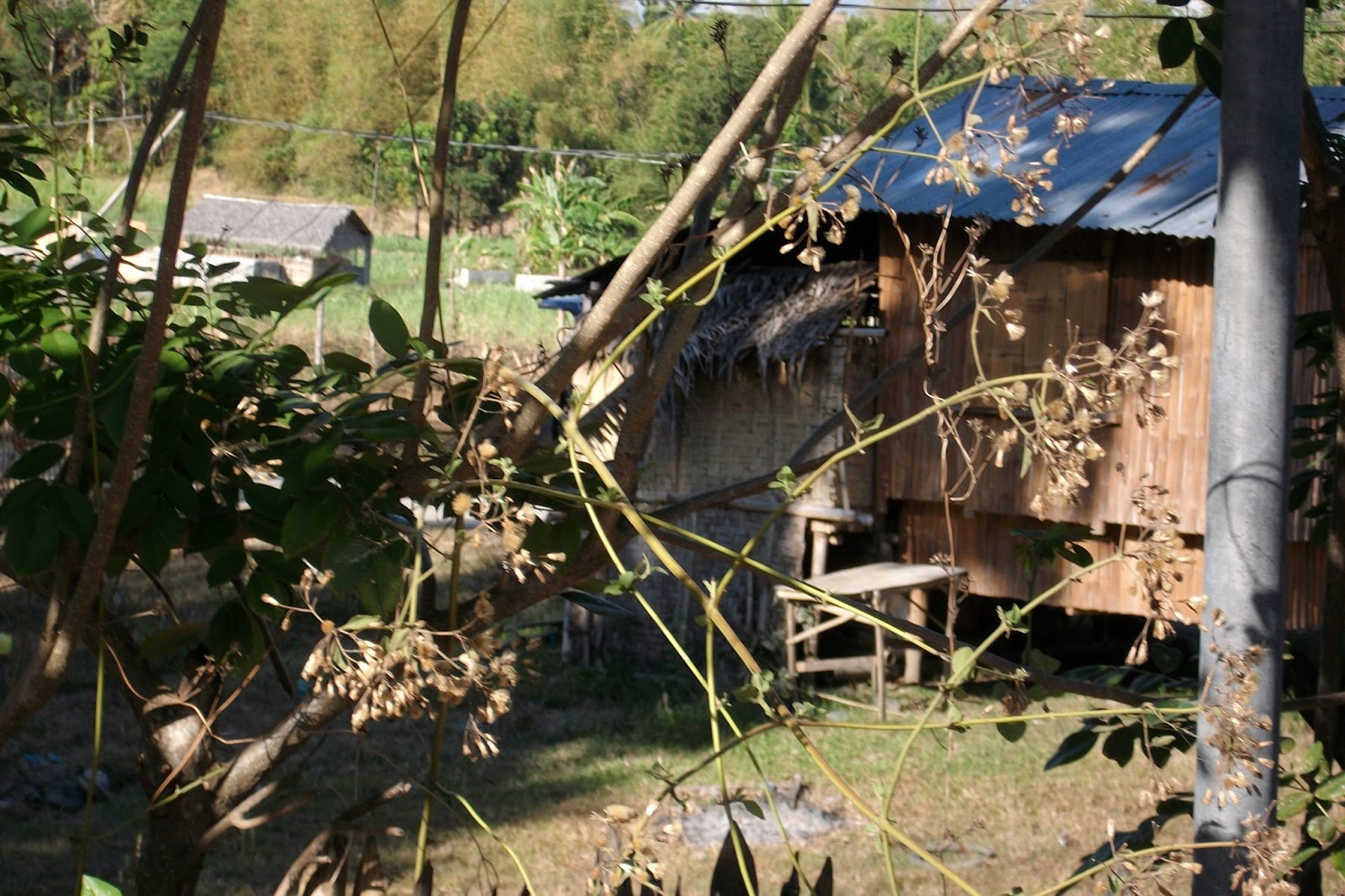
A little tin-roof bamboo house glimpsed near the road sits near a few
acres of vegetable crop-land and rice fields.  Very typical scene, amid
other much more prominent establishments.
This tower is near the road, is inside several acres of fenced and
landscaped yard-space . . . 
. . .  with this house, illustrating the contrasts often seen within a few
seconds while travelling here.
I had been wanting to get a decent photo of St. Augustine's Academy
in Patnongan for quite a while.  The vehicles I'm in rarely stop where I'd
like them to for photo purposes; but since I was in the front seat and knew
we would be "setting up" for the wide right-hand corner before the Academy,
I stuck my arm 'way out the right side, took a guess at aiming, and pushed
the button.   Yahooo - -The mirror you see is the right-front-corner of the bus.
St. A's has been around for quite a while; guess it's time for me to research it.
(LATER: online search for info about St. A's got me nothing).

Sign often seen but not observed.  Philippine drivers in general are
much more attentive and courteous than most places I have been.
They have to be so!!  The "unwritten rules" here are different - any
speed that conditions will allow is legal.  Drivers starting out MUST
look first, because in any place another vehicle may be approaching
at high speed.  Drivers already on the road will begin sounding the
horn as a precaution if they see any possible chance of a mishap.
A horn is not an insult here, it is a necessary protection.
I think we stopped just before this bridge, to pick-up or drop passengers.
Otherwise there's little chance that the Coca-Cola truck would ever be
passing us.  In our area there are a lot of familiar brand-names on trucks
and in stores.  There will be a truck blog- post sometime soon - having
been a trucker for so long, I'm surprised I haven't already done one.

Whenever this delivery tricycle goes around a corner, you'd have to
say "The Tide has turned . . ."

Belison Public Market always appears busy and bustling, with many
tricycles and other vehicles out in front.  Its well-worn appearance - -

 contrasts with the sprawling openness of school and church campuses
directly across the highway.

Arriving in SanJo (as I often abbreviate it) I switch to snapping my
photos from the back seat of a tricycle taxi, craning around to get
a shot on the left past the driver's head.  Except for tricycles, street
scenes here remind me a lot of trips we took to Tijuana, Calexico,
and Juarez, Mexico years ago.

This business has a great selection of tools, tiles, and electric and
plumbing  fixtures.  Our coach-type porch lights came from here.

Here's one of my favorite photos.  Philippine Government seems to
NOT have too much regulation, usually.  This may be an exception,
since coconuts grow wild all over the place here.  What needs any
"Authority?"  I've had a lot of fun imagining the Coconut Agents
riding around in dark tinted-glass SUVs, wearing pinstripe suits and
sunglasses but with flip-flops on their feet, calling in the SWAT team
for enforcement and negotiations . . .(smile)
(Please Note:  the foregoing is not to be taken as a criticism of any
person or agency.  It is only my attempt to be humorous about  my 
personal aversion to any perceived over-involvement by any
government in my activities, or anyone else's activities.)
Well, that's a lot of photos but as usual I've had to pick through a lot which I would  like to have included.  I think the count is more than 20 this time so I better quit.  There are all kinds of things I haven't had a chance to post on this blog yet, so I'm not quite sure which topic will grab my interest for next time.   The finishing details on our house are keeping me really busy at this time but I will try to get another posting up reasonably soon.  

Have a blessed and wonderful day, wherever you are.  Life often consists more in how we look at things (attitude) than is what those things actually are.

Tim and Bernadette Larson, Philippines